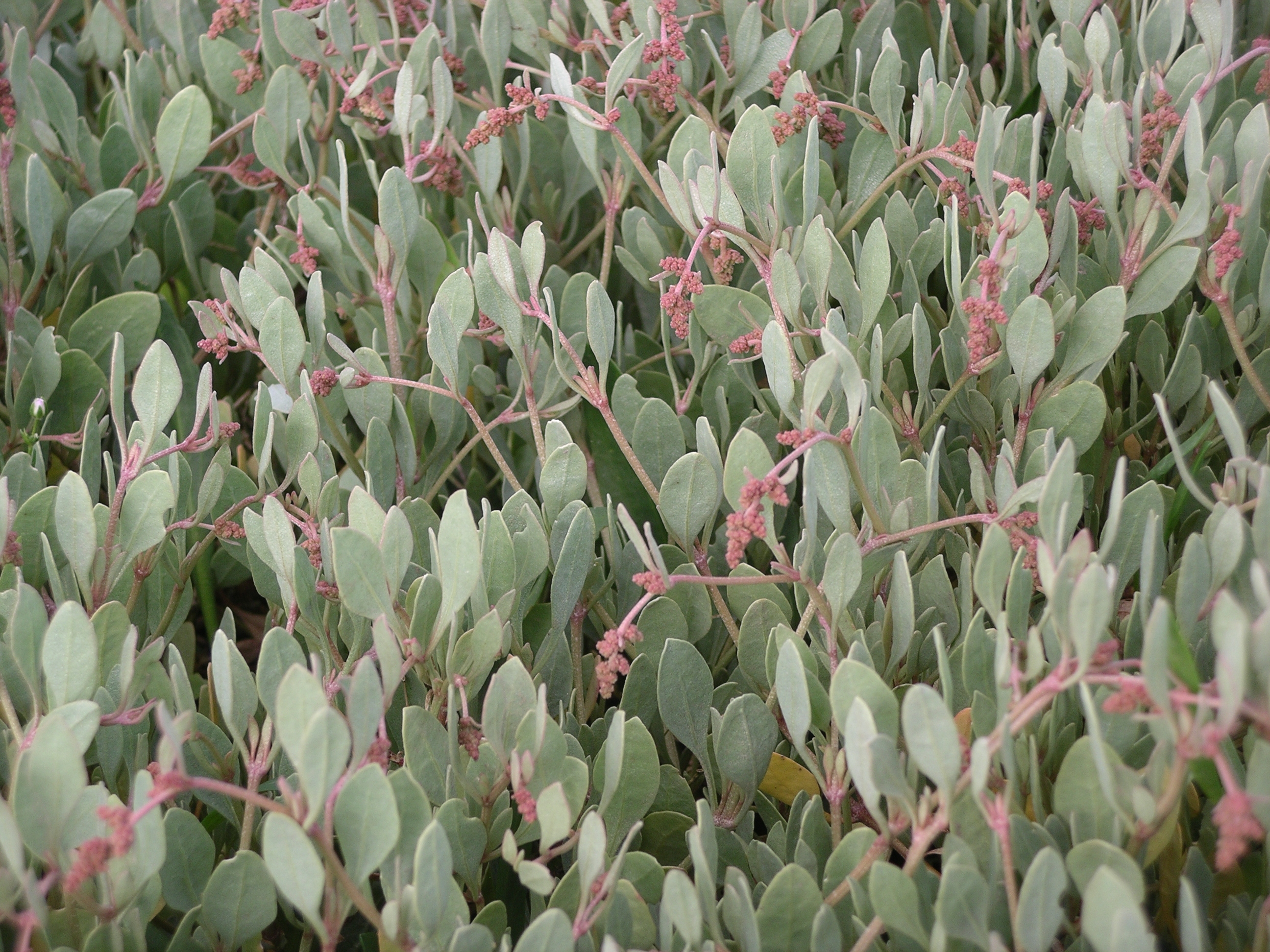
Sea Purslane
Halimione portulacoides
Photo: Wikimedia Commons (CC) via https://en.wikipedia.org/wiki/Halimione_portulacoides
Overview
Halimione portulacoides is a low-growing, evergreen shrub in the family Amaranthaceae, typically reaching 30–80 centimeters in height. Its silvery-grey, fleshy leaves are an adaptation to saline environments, allowing it to store water and excrete excess salt. The plant produces small, inconspicuous yellowish-green flowers and spreads via both seed dispersal and vegetative growth, often forming dense mats along creek edges and marsh margins.
As a pioneer species, it plays a stabilizing role in coastal ecosystems, binding sediment and facilitating the establishment of other salt-tolerant flora, while also providing shelter for invertebrates and forage for grazing waterfowl.
The species has an extensive range spanning the coastlines of Western Europe, the Mediterranean and Black Sea basins, North Africa, and parts of the Middle East and Central Asia, with additional occurrences in the United States, South Africa, and Australia. It is restricted to intertidal salt marshes, estuarine mudflats, and coastal lagoons where regular tidal inundation maintains saline soil conditions.
Its IUCN status reflects ongoing pressure on these habitats. Coastal development, urbanization, and infrastructure expansion have reduced and fragmented salt marsh extent, while sea level rise increases inundation frequency beyond the plant's tolerance in many locations. Altered hydrology from drainage, damming, and land reclamation further disrupts the salinity gradients the species depends on.
Conservation responses include salt marsh restoration projects, managed realignment schemes that allow marshes to migrate inland, and protection of estuarine habitats under regional and national coastal management frameworks. Population trends remain unquantified, leaving the trajectory of recovery efforts uncertain despite the persistence of active threats across its range.
Sea Purslane is losing its coastal marsh habitat as shorelines are built up with roads, homes, and other development, while rising sea levels and shifting weather patterns further squeeze the salty wetlands it depends on. Changes to water flow and salt levels in these areas, along with the breaking up of once-continuous marshland into smaller isolated patches, make it harder for the plant to thrive and spread. These pressures are ongoing and, given the link to climate change and continued coastal development, appear to be intensifying rather than easing.
Habitat
Salt marshes, mudflats, and brackish coastal wetlands in the upper and middle intertidal zones. Typically found in areas with moderate to high salinity levels along estuaries, coastal lagoons, and sheltered shorelines.
Other threatened species in Amaranthaceae


Threatened in Albania

Frequently asked questions
Why is Sea Purslane classified as Critically Endangered?
Where does Sea Purslane live?
What are the main threats to Sea Purslane?
Get weekly conservation intelligence
One short digest a week of the most striking species and country data we ship, plus breaking conservation news paired with our database where it matters.
Free, no spam. One-click unsubscribe in every email.