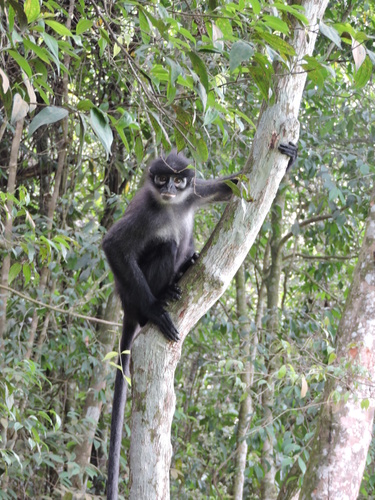
East Sumatran Banded Langur
Presbytis percura
Photo: Photo: (c) Irfan Nurarifin, some rights reserved (CC BY-NC), uploaded by Irfan Nurarifin
Overview
The East Sumatran banded langur, also known as the East Sumatran banded surili, is a species of monkey in the family Cercopithecidae. It was formerly considered a subspecies of the Raffles' banded langur Presbytis femoralis, but genetic analysis revealed it to be a separate species. Its range is restricted to the Riau Province of east-central Sumatra.
Due to its declining population and restricted range in small, isolated forests subject to high rates of deforestation, the IUCN declared it to be a critically endangered species in 2020.
Presbytis percura faces severe population decline primarily due to extensive deforestation and habitat fragmentation across its limited range in Peninsular Malaysia. Palm oil plantations and urban development have eliminated vast areas of lowland forest, while logging operations continue to degrade remaining forest fragments. The species' specialized diet and arboreal lifestyle make it particularly vulnerable to forest canopy disruption, with isolated populations showing reduced genetic diversity and reproductive success.
Habitat
This critically endangered langur inhabits primary and secondary lowland rainforests of Peninsular Malaysia, preferring the upper canopy layers of dipterocarp forests. The species requires continuous forest cover with mature trees for feeding and movement between forest patches.
Conservation measures underway
Other threatened species in CERCOPITHECIDAE


Threatened in Indonesia

Frequently asked questions
Why is East Sumatran Banded Langur classified as Critically Endangered?
Where does East Sumatran Banded Langur live?
What are the main threats to East Sumatran Banded Langur?
Get weekly conservation intelligence
One short digest a week of the most striking species and country data we ship, plus breaking conservation news paired with our database where it matters.
Free, no spam. One-click unsubscribe in every email.