Short-headed Puddle Frog
Phrynobatrachus breviceps
Overview
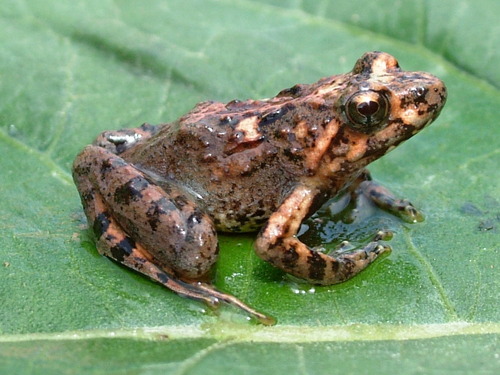
The Short-headed Puddle Frog (Phrynobatrachus breviceps) is a small, ground-dwelling amphibian belonging to the diverse Phrynobatrachidae family, whose members are typically characterized by compact bodies, short limbs, and a preference for shallow, ephemeral water bodies used for breeding. This species is known from a highly restricted range in East Africa, where it inhabits moist lowland and submontane habitats, sheltering among leaf litter, grass tussocks, and temporary puddles that form during rainy seasons. Its reliance on small, seasonal water sources makes it especially vulnerable to any disruption of local hydrology or vegetation cover.
The Short-headed Puddle Frog is classified as Critically Endangered (CR) by the IUCN, reflecting its extremely limited and fragmented distribution, ongoing habitat degradation, and the possibility that suitable breeding sites are shrinking faster than the species can adapt. Agricultural expansion, deforestation, and land conversion in its native range have reduced the availability of the specific microhabitats it depends upon, while its small range size leaves the species with little buffer against localized environmental disturbance. Because population monitoring for small, cryptic frogs like this one is logistically difficult, precise numbers remain unavailable, and the population trend is currently listed as unknown.
Despite these challenges, there is cause for cautious optimism: increased attention to amphibian conservation in East Africa has led to expanded field surveys and habitat assessments in the region, improving the chances that remaining populations can be located, studied, and protected. Continued investment in habitat protection, community-based land stewardship, and targeted amphibian surveys could meaningfully improve the outlook for this rare and little-known species.
Phrynobatrachus breviceps faces severe population decline primarily due to extensive habitat destruction from agricultural expansion and urban development across its limited range in West Africa. Mining activities and infrastructure development have further fragmented the remaining suitable breeding sites. The species' dependence on specific microhabitat conditions makes it particularly vulnerable to environmental changes, with pollution from agricultural runoff degrading water quality in critical breeding areas.
Habitat
This small frog inhabits tropical rainforest streams and seasonal pools in lowland and montane forest areas of West Africa. It requires clean, well-oxygenated water bodies with specific vegetation cover for successful breeding and larval development.
Conservation measures underway
Other threatened species in PHRYNOBATRACHIDAE
Threatened in Tanzania
Frequently asked questions
Why is Short-headed Puddle Frog classified as Critically Endangered?
Where does Short-headed Puddle Frog live?
What are the main threats to Short-headed Puddle Frog?
Get weekly conservation intelligence
One short digest a week of the most striking species and country data we ship, plus breaking conservation news paired with our database where it matters.
Free, no spam. One-click unsubscribe in every email.