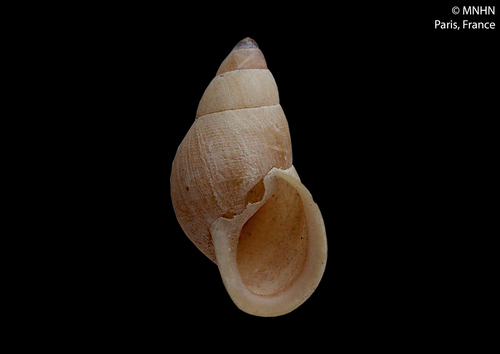
Crampton's Partula Tree Snail
Partula cramptoni
Photo: Photo: (c) André G. J. DELSAERDT, some rights reserved (CC BY)
Overview
Crampton's Partula tree snail (Partula cramptoni) is a small, air-breathing land snail once native to the misty valleys of Tahiti in French Polynesia. Like other Partula tree snails, it bears a coiled, glossy shell typically banded in shades of brown, yellow, or cream, and is arboreal, clinging to the undersides of leaves in humid forest understory where it feeds on decaying plant matter and fungal growth. This species is classified as Critically Endangered (CR) by the IUCN, a status reflecting the catastrophic collapse of Tahiti's native Partula snail fauna over the past four decades.
The primary driver of decline was the deliberate introduction of the predatory rosy wolfsnail (Euglandina rosea) in the 1970s, intended as a biological control agent for the invasive giant African land snail but which instead devastated native Partula populations across French Polynesia, driving many species extinct in the wild within a few short years. Habitat degradation from agricultural expansion and human settlement in Tahiti's valleys has compounded pressure on remaining populations. Because Partula cramptoni is restricted to a narrow native range with no natural defenses against introduced predators, wild sightings have become exceedingly rare, and population trends remain unknown due to the difficulty of surveying surviving individuals.
On a more hopeful note, this species is part of an internationally coordinated ex-situ breeding program involving zoos and conservation institutions across Europe and the United States, which has successfully maintained captive assurance populations of related Partula species and supported experimental reintroduction efforts in predator-controlled enclosures on Tahiti. These captive breeding successes offer a genuine pathway toward eventual recovery, demonstrating that even for snails pushed to the brink, coordinated global conservation action can preserve genetic lineages for the future.
Partula cramptoni faces extinction primarily due to predation by the introduced carnivorous snail Euglandina rosea, which was deliberately introduced to Pacific islands in the 1970s as a misguided biological control agent. The species has also suffered from habitat destruction through deforestation and urban development on its native Pacific island range. Competition from other introduced species and the small, fragmented nature of remaining populations further threaten this critically endangered tree snail.
Habitat
Partula cramptoni inhabits native tropical forests and woodland areas on Pacific islands, typically found on trees and vegetation in humid, shaded environments. The species requires specific microhabitat conditions including appropriate moisture levels and native plant communities that support its feeding and reproductive needs.
Other threatened species in PARTULIDAE

Threatened in Solomon Islands
Frequently asked questions
Why is Crampton's Partula Tree Snail classified as Critically Endangered?
Where does Crampton's Partula Tree Snail live?
What are the main threats to Crampton's Partula Tree Snail?
Get weekly conservation intelligence
One short digest a week of the most striking species and country data we ship, plus breaking conservation news paired with our database where it matters.
Free, no spam. One-click unsubscribe in every email.