Wiley's Glassfrog
Nymphargus wileyi
Overview
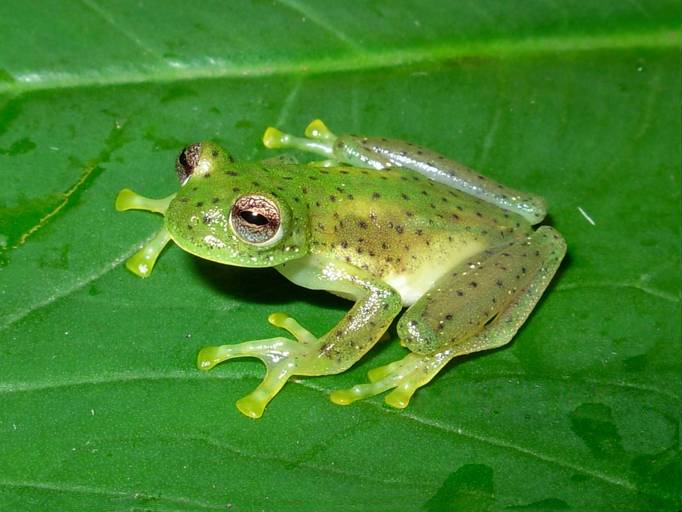
Wiley's Glassfrog (Nymphargus wileyi) is a small, translucent-skinned amphibian belonging to the family Centrolenidae, a group renowned for their glass-like ventral skin that in many species reveals internal organs, including the beating heart. Like its relatives, this species is likely lime-green above with a pale, semi-transparent underside, and large forward-facing eyes adapted for its nocturnal, arboreal lifestyle. It inhabits humid montane forest along streams and rivers in Ecuador's Andean foothills, where males call from vegetation overhanging flowing water and females deposit egg clutches on leaves suspended above the stream, allowing hatched tadpoles to drop directly into the current below.
The species is classified as Critically Endangered (CR) by the IUCN, with a population trend that is decreasing. Its restricted range makes it especially vulnerable to habitat degradation, and ongoing deforestation for agriculture, logging, and human settlement within its narrow elevational band continues to fragment the cloud forest streams it depends on. Glassfrogs as a group are also highly sensitive to changes in water quality and stream hydrology, meaning even localized disturbances can eliminate breeding sites.
Conservation attention for Ecuadorian glassfrogs has grown substantially in recent years, with several private and community-managed reserves in the eastern Andean slopes now protecting stream habitats critical to threatened centrolenids. Herpetological surveys continue to refine understanding of this species' distribution, and its formal description has helped draw scientific and conservation focus to an otherwise overlooked corner of Ecuador's amphibian diversity. While Wiley's Glassfrog remains at serious risk of extinction, the expansion of protected forest corridors in the region offers a genuine and encouraging opportunity to safeguard the remaining populations and the unique stream ecosystems they inhabit.
Nymphargus wileyi faces severe threats from habitat destruction due to agricultural expansion and cattle ranching in its limited montane cloud forest range. The species' extremely restricted distribution makes it particularly vulnerable to localized environmental changes, while climate change poses additional risks by altering the delicate moisture conditions essential for cloud forest ecosystems. Water pollution from agricultural runoff and pesticide use further threatens both adult frogs and their aquatic larval stages.
Habitat
This glass frog inhabits pristine montane cloud forests at elevations between 1,800-2,400 meters in the Cordillera Oriental of Colombia. It requires the constant moisture and stable temperatures provided by cloud forest environments, typically found near streams and water bodies within these high-altitude ecosystems.
Conservation measures underway
Other threatened species in CENTROLENIDAE
Frequently asked questions
Why is Wiley's Glassfrog classified as Critically Endangered?
Where does Wiley's Glassfrog live?
What are the main threats to Wiley's Glassfrog?
Get weekly conservation intelligence
One short digest a week of the most striking species and country data we ship, plus breaking conservation news paired with our database where it matters.
Free, no spam. One-click unsubscribe in every email.