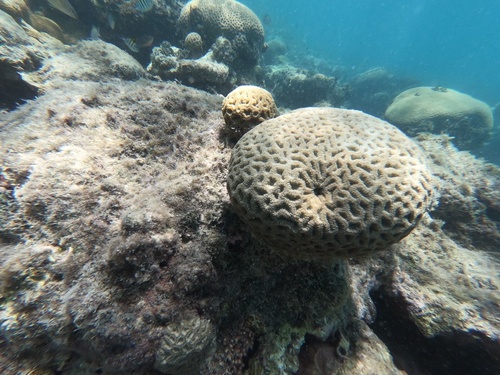
Bahia Brain Coral
CR

Bahia Brain Coral

Mussismilia braziliensis

Declining

Photo: Photo: (c) Bruno Ielpo, all rights reserved, uploaded by Bruno Ielpo

Overview

The Bahia Brain Coral (Mussismilia braziliensis) is a large, dome-shaped reef-building coral endemic to Brazil, distinguished by the meandering, brain-like grooves of its skeleton and polyps that range from brownish-green to yellow-tan. It is one of the principal architects of Brazil's unique reef systems, found nowhere else on Earth, making its survival critical to the country's marine biodiversity heritage. This species is restricted to the coastal waters of Bahia and neighboring states in northeastern Brazil, where it forms and cements the structural framework of shallow reef habitats, often in turbid, sediment-influenced waters unlike the clearer reefs typical of the Caribbean or Indo-Pacific.

The species is currently classified as Critically Endangered (CR) by the IUCN, reflecting severe and ongoing population declines driven by a combination of pressures unique to its restricted Brazilian range. Its endemism, combined with a naturally limited distribution, leaves it with little capacity to recover losses or recolonize damaged reef areas from elsewhere. On the positive side, Mussismilia braziliensis occurs within several Brazilian marine protected areas, including portions of the Abrolhos Marine National Park, one of the most extensive coral reef complexes in the South Atlantic, where active monitoring and reef restoration trials are underway.

Researchers and Brazilian conservation authorities have also prioritized this species in national coral conservation strategies, and captive propagation techniques are being explored to support future restoration. Continued investment in water quality management, sedimentation control from coastal development, and expansion of no-take marine zones offers a genuine, if narrow, pathway to stabilizing remaining populations. Public awareness campaigns highlighting the species as a national natural treasure have also helped galvanize local support for reef protection efforts along the Bahia coast.

Mussismilia braziliensis faces severe decline from ocean warming and acidification, which cause coral bleaching and reduce calcification rates essential for skeletal growth. Coastal development and sedimentation from urban runoff smother coral colonies and degrade water quality in shallow reef environments. Disease outbreaks, particularly white plague and black band disease, have caused widespread mortality across Brazilian reef systems where this endemic coral occurs.

Threat summary

Habitat

This endemic Brazilian coral species inhabits shallow coastal reefs and rocky substrates along the Brazilian coast, typically in depths of 1-20 meters. It forms colonies on hard surfaces in warm tropical waters with moderate to strong water movement.

Marine neritic· major

Conservation measures underway

Habitat & natural process restorationSpecies recoveryLegislation

Frequently asked questions

Why is Bahia Brain Coral classified as Critically Endangered?
Bahia Brain Coral is classified as Critically Endangered — facing an extremely high risk of extinction in the wild — because population sizes are very small, declining sharply, or restricted to a tiny range. Mussismilia braziliensis faces severe decline from ocean warming and acidification, which cause coral bleaching and reduce calcification rates essential for skeletal growth. Coastal development and sedimentation from urban runoff smother coral colonies and degrade water quality in shallow reef environments. Disease outbreaks, particularly white plague and black band disease, have caused widespread mortality across Brazilian reef systems where this endemic coral occurs.
Where does Bahia Brain Coral live?
Bahia Brain Coral occurs in Brazil. Country-level distribution data is sourced from the IUCN Red List and cross-referenced with GBIF occurrences.
What are the main threats to Bahia Brain Coral?
The main threats to Bahia Brain Coral are 11.1, 2.1, 5.4, and 6.1. The full IUCN-classified threat record for this species is detailed on the species page.

Get weekly conservation intelligence

One short digest a week of the most striking species and country data we ship, plus breaking conservation news paired with our database where it matters.

Free, no spam. One-click unsubscribe in every email.