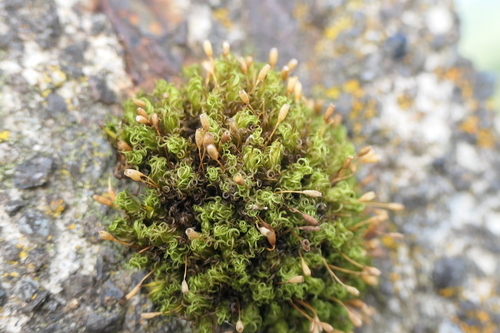
Long-shanked Pincushion
Ptychomitrium polyphyllum
The Long-shanked Pincushion (Ptychomitrium polyphyllum) is a small acrocarpous moss characterized by its distinctive cushion-like growth form and elongated setae (stalks) that give it its common name. This bryophyte forms compact, dark green to brownish tufts with densely packed leaves that create a characteristic pincushion appearance when viewed from above.
Taxonomy & Classification
Kingdom
Plantae
Phylum
Bryophyta
Class
Bryopsida
Order
Grimmiales
Family
Ptychomitriaceae
Genus
Ptychomitrium
Long-shanked Pincushion belongs to the family Ptychomitriaceae, order Grimmiales, within the Bryopsida class.
Species Profile
The Long-shanked Pincushion (Ptychomitrium polyphyllum) is a small acrocarpous moss characterized by its distinctive cushion-like growth form and elongated setae (stalks) that give it its common name. This bryophyte forms compact, dark green to brownish tufts with densely packed leaves that create a characteristic pincushion appearance when viewed from above. As a pioneer species, it plays a crucial role in soil stabilization and provides microhabitat for invertebrates in rocky environments.
The Long-shanked Pincushion (Ptychomitrium polyphyllum) is critically endangered due to its extremely limited distribution and vulnerability to habitat degradation. This moss species faces severe threats from human activities that alter its specialized rocky habitat requirements and microclimate conditions.
Key Facts
Habitat & Distribution
Ptychomitrium polyphyllum inhabits exposed siliceous rock faces, cliff crevices, and boulder fields, typically in areas with intermittent moisture from seepage or fog. The species shows a strong preference for acidic substrates and is often found on vertical or near-vertical rock surfaces where it can establish in thin soil accumulations within rock fissures.
Threats
IUCN Red List: Critically Endangered
The Long-shanked Pincushion (Ptychomitrium polyphyllum) is critically endangered due to its extremely limited distribution and vulnerability to habitat degradation. This moss species faces severe threats from human activities that alter its specialized rocky habitat requirements and microclimate conditions.
Air pollution and acid deposition
Climate change and altered precipitation patterns
Habitat destruction and fragmentation
Quarrying and rock extraction
Recreational activities and trampling
National vs Global Threat Status
How this species is assessed at the national level compared to its IUCN global status (CR).
| Country | National Status | Global Status | Comparison |
|---|---|---|---|
| EU | LCLeast Concern | CRCritically Endangered | Lower local risk |
| EU | LCLeast Concern | CRCritically Endangered | Lower local risk |
National Red List data sourced from the National Red List Project (nationalredlist.org, ZSL) and country-specific Red List authorities.
Community Sightings
Report a sightingNo community sightings yet. Be the first to report!
Sources & Attribution
How to Cite
IUCN: IUCN (2025). The IUCN Red List of Threatened Species. Version 2025-1. Available at: https://www.iucnredlist.org. doi:10.2305/IUCN.UK.2025-1.RLTS
GBIF: GBIF.org (2025). GBIF Home Page. Available at: https://www.gbif.org
National Red Lists: ZSL (2025). National Red List. Zoological Society of London. Available at: https://www.nationalredlist.org
This page: SpeciesRadar (2025). Long-shanked Pincushion (Ptychomitrium polyphyllum). SpeciesRadar: Intelligence for Earth's Biodiversity. Available at: https://speciesradar.org/species/long-shanked-pincushion