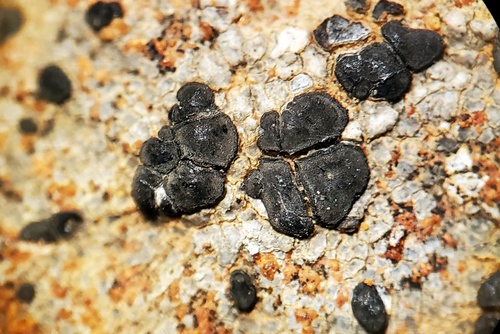
lecidea lichen
Lecidea diducens
Photo: (c) Jason Dart, some rights reserved (CC BY-NC), uploaded by Jason Dart
Overview
Lecidea diducens is a crustose lichen, a lichen form that grows as a thin, encrusted layer fused tightly to its substrate rather than forming leafy or shrubby structures. Like other members of the genus Lecidea, it likely produces small, dark, disc-shaped fruiting bodies (apothecia) set against a pale to grey thallus, a structure adapted to withstand exposure on bare rock surfaces. This species is classified as Critically Endangered (CR) by the IUCN, reflecting an extremely restricted range and acute vulnerability to further decline.
Crustose lichens in this genus typically occupy specialized rock or siliceous substrates in open, often montane or coastal habitats where competition from faster-growing vegetation is limited. Because lichens such as Lecidea diducens grow by slow accretion, often only fractions of a millimetre per year, populations can take centuries to recover from disturbance, making any habitat alteration disproportionately damaging. Its CR status indicates that the known population is confined to one or very few localities, leaving it acutely exposed to localized threats such as habitat degradation, pollution, or changes in microclimate.
Conservation attention for narrow-range lichens like this has been growing as part of broader efforts to document and protect lichen biodiversity, which has historically received far less survey effort than vascular plants or vertebrates. On a positive note, increasing interest from lichenologists in cataloguing rare crustose species has improved the likelihood that remaining populations of Lecidea diducens will be rediscovered, monitored, and factored into site-level conservation planning, offering a genuine opportunity to prevent its further decline before it is too late.
Lecidea diducens faces severe threats from atmospheric pollution and acid deposition, which alter the chemical composition of its rock substrates and disrupt the delicate pH balance required for lichen survival. Climate change compounds these pressures through altered precipitation patterns and temperature fluctuations that affect the species' ability to photosynthesize and reproduce. The lichen's extremely restricted range makes it particularly vulnerable to local environmental changes, with entire populations potentially eliminated by single disturbance events.
Habitat
Lecidea diducens is a crustose lichen that grows exclusively on siliceous rock surfaces in montane and subalpine environments. The species requires specific microclimate conditions with clean air, stable moisture levels, and particular rock chemistry to establish and maintain viable populations.
Other threatened species in Lecideaceae
Frequently asked questions
Why is lecidea lichen classified as Critically Endangered?
Where does lecidea lichen live?
What are the main threats to lecidea lichen?
Get weekly conservation intelligence
One short digest a week of the most striking species and country data we ship, plus breaking conservation news paired with our database where it matters.
Free, no spam. One-click unsubscribe in every email.