CRCritically Endangered

Horned Dung Beetle

Copris lunaris

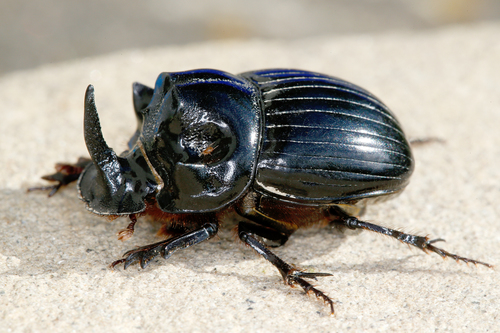
The Horned Dung Beetle (Copris lunaris) is a large, robust scarab beetle distinguished by the prominent horn-like projections on the male's head and thorax, which are used in territorial combat. These beetles play a crucial ecological role as decomposers, burying and processing mammalian dung to create nutrient-rich brood balls for their larvae, thereby cycling nutrients back into soil ecosystems.

01Classification

Taxonomy & Classification

Kingdom

Animalia

Phylum

Arthropoda

Class

Insecta

Order

Coleoptera

Family

Scarabaeidae

Genus

Copris

Horned Dung Beetle belongs to the family Scarabaeidae, order Coleoptera, within the Insecta class.

02Description

Species Profile

The Horned Dung Beetle (Copris lunaris) is a large, robust scarab beetle distinguished by the prominent horn-like projections on the male's head and thorax, which are used in territorial combat. These beetles play a crucial ecological role as decomposers, burying and processing mammalian dung to create nutrient-rich brood balls for their larvae, thereby cycling nutrients back into soil ecosystems.

The Horned Dung Beetle (Copris lunaris) has experienced severe population declines primarily due to habitat loss and degradation of grassland ecosystems across Europe. Agricultural intensification, including the widespread use of veterinary medicines like ivermectin that contaminate dung and reduce insect survival, has significantly impacted populations. The species' dependence on large mammal dung and traditional pastoral systems makes it particularly vulnerable to modern farming practices.

Key Facts

IUCN StatusCritically Endangered (CR)
GroupInsects
03Habitat

Habitat & Distribution

Horned Dung Beetles inhabit open grasslands, pastures, and woodland edges where large herbivorous mammals graze, requiring areas with loose, well-draining soils suitable for excavating deep burrows beneath fresh dung deposits.

04Threats

Threats

!

IUCN Red List: Critically Endangered

The Horned Dung Beetle (Copris lunaris) has experienced severe population declines primarily due to habitat loss and degradation of grassland ecosystems across Europe. Agricultural intensification, including the widespread use of veterinary medicines like ivermectin that contaminate dung and reduce insect survival, has significantly impacted populations. The species' dependence on large mammal dung and traditional pastoral systems makes it particularly vulnerable to modern farming practices.

Agricultural intensification and habitat loss

HighOngoing

Decline of traditional pastoral systems

HighOngoing

Veterinary medicine contamination in livestock dung

HighOngoing

Grassland habitat fragmentation

MediumOngoing

Reduced availability of suitable dung resources

MediumOngoing
Community

Community Sightings

Report a sighting

No community sightings yet. Be the first to report!

07Sources

Sources & Attribution

How to Cite

IUCN: IUCN (2025). The IUCN Red List of Threatened Species. Version 2025-1. Available at: https://www.iucnredlist.org. doi:10.2305/IUCN.UK.2025-1.RLTS

GBIF: GBIF.org (2025). GBIF Home Page. Available at: https://www.gbif.org

This page: SpeciesRadar (2025). Horned Dung Beetle (Copris lunaris). SpeciesRadar: Intelligence for Earth's Biodiversity. Available at: https://speciesradar.org/species/horned-dung-beetle

Full citation guide & data usage terms