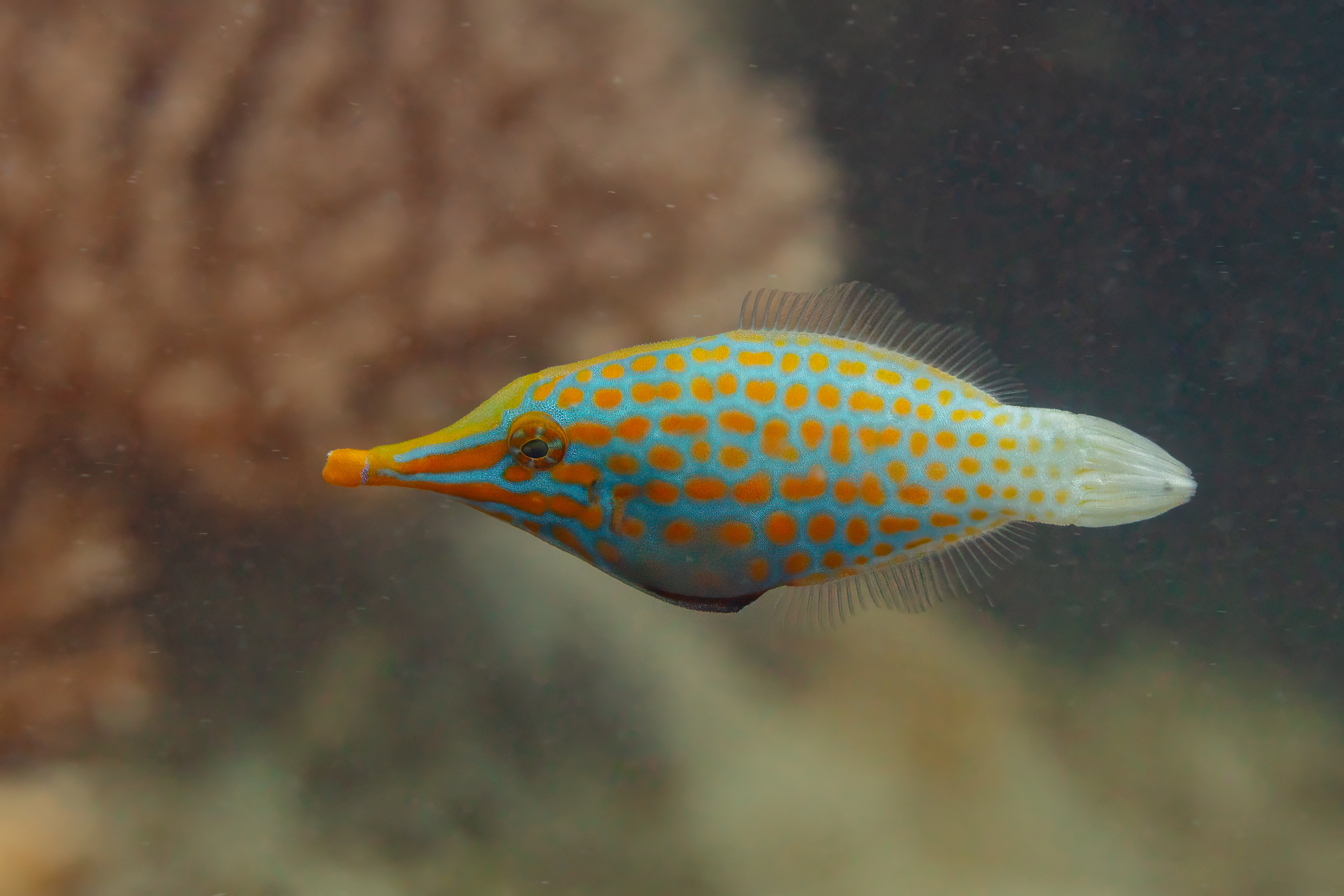
Harlequin Filefish
Oxymonacanthus longirostris
Photo: Wikimedia Commons (CC) via https://en.wikipedia.org/wiki/Orange_spotted_filefish
Overview
This small, brightly patterned reef fish is easily recognized by its elongated snout, blue-and-orange lattice markings, and laterally compressed body. It swims with a distinctive slow, hovering motion using its dorsal and anal fins, often in mated pairs that remain closely associated with a single coral colony. Its diet is highly specialized, consisting almost exclusively of the live polyps of Acropora coral, making it both a coral predator and an indicator species closely tied to the health of branching coral communities.
It plays a minor but specific ecological role in reef food webs and serves as a bioindicator of coral reef condition.
The species is widely distributed across the Indo-Pacific, occurring in marine coastal and coral reef habitats from East Africa and the Red Sea through the Indian Ocean to Southeast Asia, Japan, Australia, and numerous Pacific island nations. It depends on shallow, clear-water reef systems rich in live Acropora growth.
Its population is declining primarily due to habitat degradation. Logging and wood harvesting on adjacent coastlines increase sediment runoff, smothering coral reefs and reducing live coral cover. Fishing and harvesting of aquatic resources, including destructive practices affecting reef structure, further reduce suitable habitat.
Because the species feeds almost exclusively on live coral polyps, it is unusually vulnerable to reef degradation compared to more generalist reef fish.
Conservation efforts are largely indirect, arising from broader marine protected area networks and coral reef management programs across its range states, several of which have established marine reserves covering portions of its habitat. Targeted, species-specific conservation measures remain limited.
Given its obligate dependence on live coral and continuing reef decline across much of its range, the species' population is expected to continue decreasing unless coral habitat loss is slowed.
Harlequin Filefish are affected by logging and wood harvesting activities on land, which can degrade coastal habitats and coral reef water quality through runoff and sedimentation. They are also impacted by fishing and harvesting of aquatic resources, including capture for the aquarium trade. Both threats are currently ongoing, suggesting a stable but persistent level of pressure on the species.
Habitat
Other threatened species in MONACANTHIDAE
Threatened in American Samoa
Frequently asked questions
Why is Harlequin Filefish classified as Vulnerable?
Where does Harlequin Filefish live?
What are the main threats to Harlequin Filefish?
Get weekly conservation intelligence
One short digest a week of the most striking species and country data we ship, plus breaking conservation news paired with our database where it matters.
Free, no spam. One-click unsubscribe in every email.