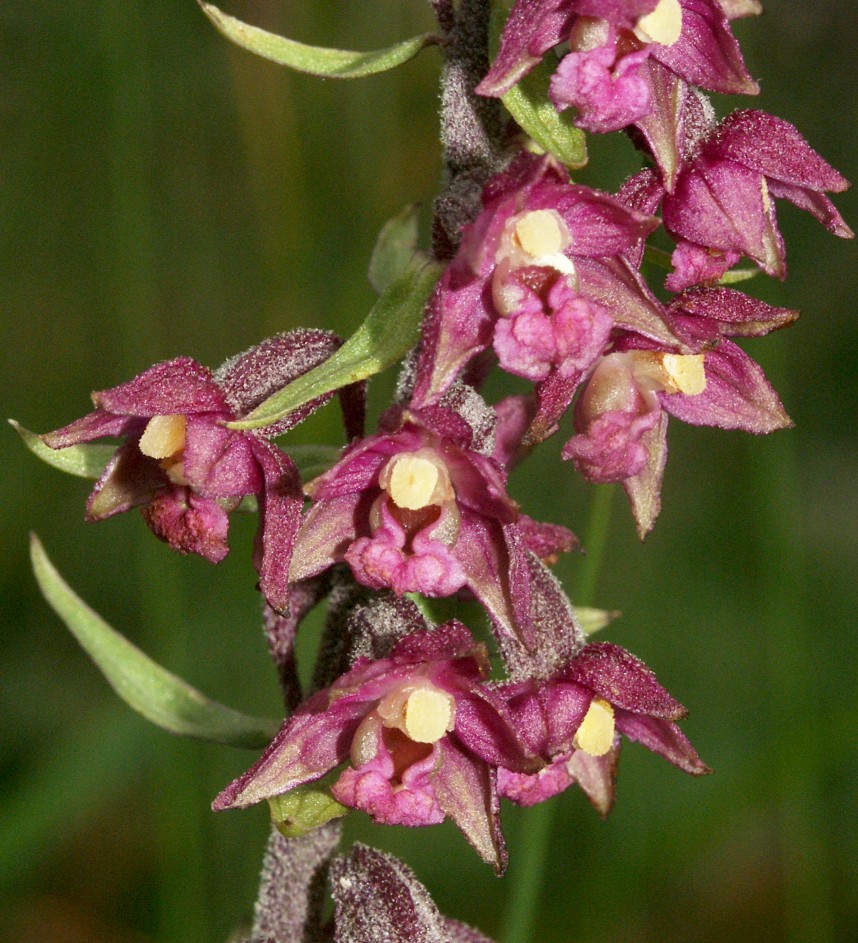
Gymnadenia nigra
ENEndangered

Gymnadenia nigra

Local name: Gymnadénie noire, Gymnadénia noir, Nigritelle noire, Orchis vanille

Gymnadenia nigra, also known as the black vanilla orchid, is a species of orchid and the provincial flower of Jämtland, a historical province of Sweden. It is a perennial species found in the major mountain ranges of Europe, including the Pyrenees and the Alps, into the Balkans and central Scandinavia, though its population has declined in the past decades due to over-harvesting.

Photo: Wikimedia Commons (CC) via https://en.wikipedia.org/wiki/Gymnadenia_nigra

01Classification

Taxonomy & Classification

Kingdom

Plantae

Phylum

Tracheophyta

Class

Liliopsida

Order

Asparagales

Family

Orchidaceae

Genus

Gymnadenia

Gymnadenia nigra belongs to the family Orchidaceae, order Asparagales, within the Liliopsida class.

02Description

Species Profile

Gymnadenia nigra, also known as the black vanilla orchid, is a species of orchid and the provincial flower of Jämtland, a historical province of Sweden. It is a perennial species found in the major mountain ranges of Europe, including the Pyrenees and the Alps, into the Balkans and central Scandinavia, though its population has declined in the past decades due to over-harvesting. In some countries, including Italy, it is listed as an endangered species. It has a maximum height of 25 cm.

Gymnadenia nigra is declining primarily due to habitat loss and degradation of its specialized alpine and subalpine grassland environments. Climate change poses an additional significant threat as warming temperatures force this cold-adapted species to retreat to higher elevations with increasingly limited suitable habitat.

Key Facts

IUCN StatusEndangered (EN)
GroupPlants
04Threats

Threats

!

IUCN Red List: Endangered

Gymnadenia nigra is declining primarily due to habitat loss and degradation of its specialized alpine and subalpine grassland environments. Climate change poses an additional significant threat as warming temperatures force this cold-adapted species to retreat to higher elevations with increasingly limited suitable habitat.

Climate change and warming temperatures

HighOngoing

Habitat loss and fragmentation from agricultural intensification

HighOngoing

Changes in traditional land management practices

MediumOngoing

Overgrazing by livestock

MediumOngoing

Tourism and recreational trampling

MediumOngoing
07National Status

National vs Global Threat Status

How this species is assessed at the national level compared to its IUCN global status (EN).

CountryNational StatusGlobal StatusComparison
EULCLeast ConcernENEndangeredLower local risk

National Red List data sourced from the National Red List Project (nationalredlist.org, ZSL) and country-specific Red List authorities.

Community

Community Sightings

Report a sighting

No community sightings yet. Be the first to report!

07Sources

Sources & Attribution

How to Cite

IUCN: IUCN (2025). The IUCN Red List of Threatened Species. Version 2025-1. Available at: https://www.iucnredlist.org. doi:10.2305/IUCN.UK.2025-1.RLTS

GBIF: GBIF.org (2025). GBIF Home Page. Available at: https://www.gbif.org

National Red Lists: ZSL (2025). National Red List. Zoological Society of London. Available at: https://www.nationalredlist.org

This page: SpeciesRadar (2025). Gymnadenia nigra (Gymnadenia nigra). SpeciesRadar: Intelligence for Earth's Biodiversity. Available at: https://speciesradar.org/species/gymnadenie-noire-gymnadenia-noir-nigritelle-noire-orchis-vanille

Full citation guide & data usage terms