Grove Earwort
Scapania nemorea
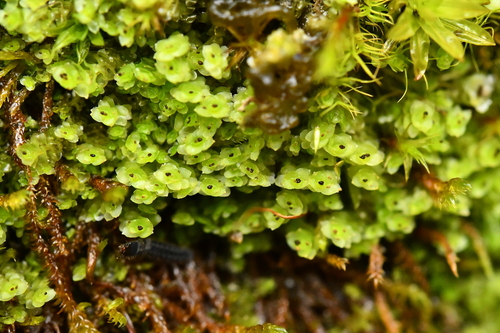
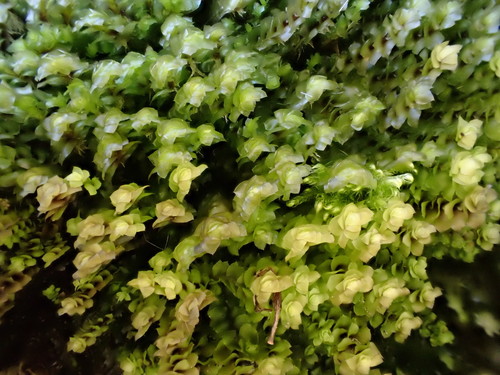
Grove Earwort (Scapania nemorea) is a small leafy liverwort characterized by its distinctive two-lobed leaves where the smaller dorsal lobe overlaps the larger ventral lobe, creating a characteristic 'earwort' appearance. This bryophyte typically forms loose patches or scattered shoots on acidic substrates and plays an important ecological role in forest ecosystems by contributing to nutrient cycling and providing microhabitat for invertebrates.
Taxonomy & Classification
Kingdom
Plantae
Phylum
Marchantiophyta
Class
Jungermanniopsida
Order
Jungermanniales
Family
Scapaniaceae
Genus
Scapania
Grove Earwort belongs to the family Scapaniaceae, order Jungermanniales, within the Jungermanniopsida class.
Species Profile
Grove Earwort (Scapania nemorea) is a small leafy liverwort characterized by its distinctive two-lobed leaves where the smaller dorsal lobe overlaps the larger ventral lobe, creating a characteristic 'earwort' appearance. This bryophyte typically forms loose patches or scattered shoots on acidic substrates and plays an important ecological role in forest ecosystems by contributing to nutrient cycling and providing microhabitat for invertebrates.
Grove Earwort (Scapania nemorea) is declining primarily due to habitat loss and degradation from deforestation, agricultural expansion, and urban development. The species is also threatened by air pollution, particularly nitrogen deposition, and climate change impacts that alter moisture regimes in its specialized woodland habitats.
Key Facts
Habitat & Distribution
Grove Earwort inhabits the bark of deciduous trees, rotting logs, and acidic soil in mature woodlands, particularly favoring shaded areas with high humidity. It is most commonly found in ancient forests and well-established woodland areas where stable microclimatic conditions persist.
Threats
IUCN Red List: Endangered
Grove Earwort (Scapania nemorea) is declining primarily due to habitat loss and degradation from deforestation, agricultural expansion, and urban development. The species is also threatened by air pollution, particularly nitrogen deposition, and climate change impacts that alter moisture regimes in its specialized woodland habitats.
Air pollution and nitrogen deposition
Habitat loss from deforestation and land conversion
Agricultural intensification
Climate change and altered precipitation patterns
Fragmentation of woodland habitats
National vs Global Threat Status
How this species is assessed at the national level compared to its IUCN global status (EN).
| Country | National Status | Global Status | Comparison |
|---|---|---|---|
| EU | LCLeast Concern | ENEndangered | Lower local risk |
| EU | LCLeast Concern | ENEndangered | Lower local risk |
National Red List data sourced from the National Red List Project (nationalredlist.org, ZSL) and country-specific Red List authorities.
Community Sightings
Report a sightingNo community sightings yet. Be the first to report!
Sources & Attribution
How to Cite
IUCN: IUCN (2025). The IUCN Red List of Threatened Species. Version 2025-1. Available at: https://www.iucnredlist.org. doi:10.2305/IUCN.UK.2025-1.RLTS
GBIF: GBIF.org (2025). GBIF Home Page. Available at: https://www.gbif.org
National Red Lists: ZSL (2025). National Red List. Zoological Society of London. Available at: https://www.nationalredlist.org
This page: SpeciesRadar (2025). Grove Earwort (Scapania nemorea). SpeciesRadar: Intelligence for Earth's Biodiversity. Available at: https://speciesradar.org/species/grove-earwort