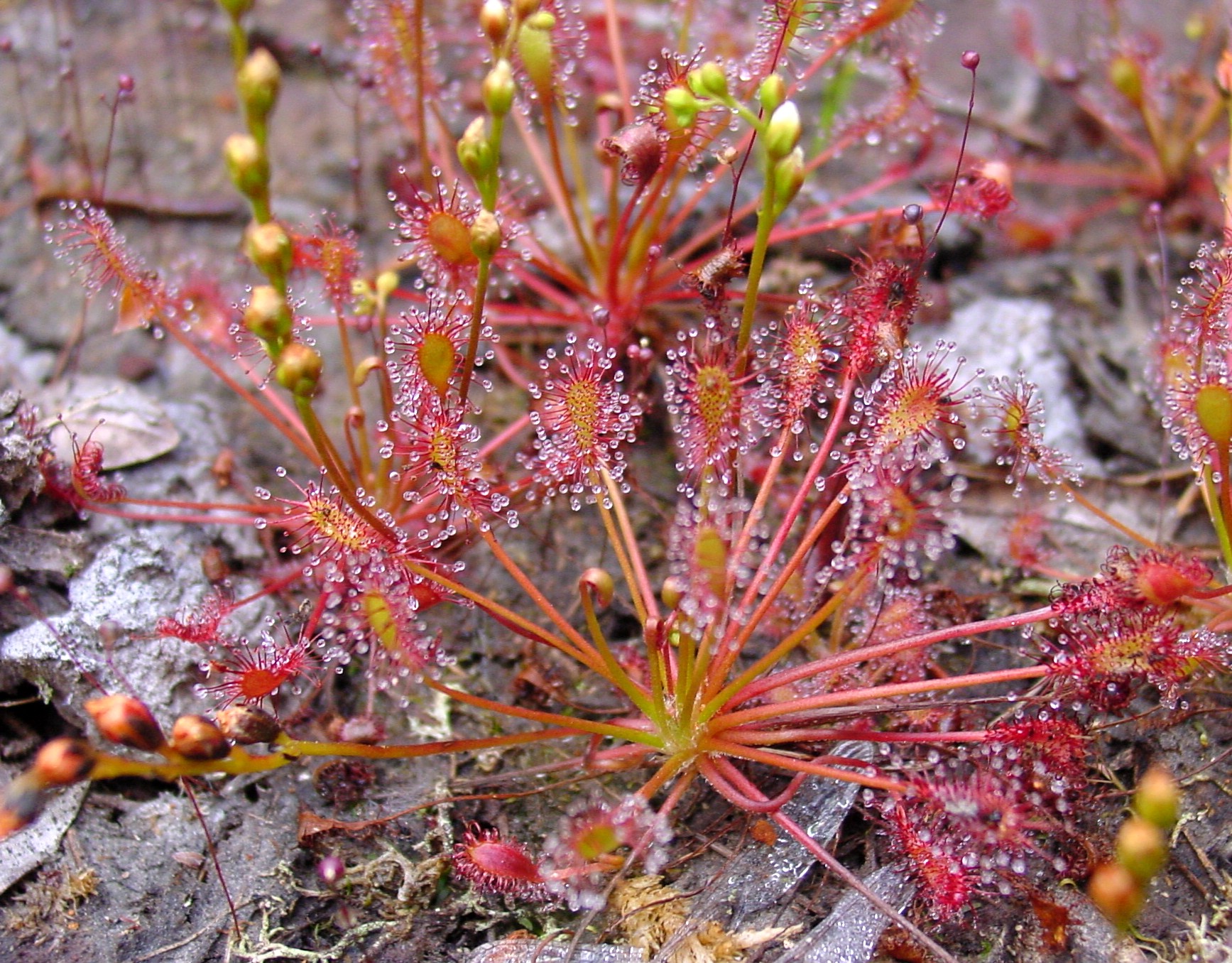
Great Sundew
ENEndangered

Great Sundew

Drosera anglica

Drosera anglica, commonly known as the English sundew or great sundew, is a carnivorous flowering plant species belonging to the sundew family Droseraceae. It is a temperate species with a circumboreal range, although it does occur as far south as Japan, southern Europe, and the island of Kauai in Hawaii, where it grows as a tropical sundew.

Photo: Wikimedia Commons (CC) via https://en.wikipedia.org/wiki/Drosera_anglica

01Classification

Taxonomy & Classification

Kingdom

Plantae

Phylum

Tracheophyta

Class

Magnoliopsida

Order

Caryophyllales

Family

Droseraceae

Genus

Drosera

Great Sundew belongs to the family Droseraceae, order Caryophyllales, within the Magnoliopsida class.

02Description

Species Profile

Drosera anglica, commonly known as the English sundew or great sundew, is a carnivorous flowering plant species belonging to the sundew family Droseraceae. It is a temperate species with a circumboreal range, although it does occur as far south as Japan, southern Europe, and the island of Kauai in Hawaii, where it grows as a tropical sundew. It is thought to originate from an amphidiploid hybrid of D. rotundifolia and D. linearis, meaning that a sterile hybrid between these two species doubled its chromosomes to produce fertile progeny which stabilized into the current D. anglica.

Great Sundew populations are declining primarily due to habitat loss from wetland drainage, peat bog destruction, and agricultural conversion of its specialized bog habitats. Climate change and altered hydrology further threaten the specific water chemistry and moisture conditions this carnivorous plant requires to survive.

Key Facts

IUCN StatusEndangered (EN)
GroupPlants
03Habitat

Habitat & Distribution

D. anglica growing on a quaking bog in the Wallowa Mountains of Oregon Drosera anglica grows in open, non-forested habitat with wet, often calcium-rich soils. These include bogs, marl fens, quaking bogs, cobble shores, and other calcareous habitats. This tolerance of calcium is relatively rare in the rest of the genus. D. anglica is often associated with various sphagnum mosses, and many times...

04Threats

Threats

!

IUCN Red List: Endangered

Great Sundew populations are declining primarily due to habitat loss from wetland drainage, peat bog destruction, and agricultural conversion of its specialized bog habitats. Climate change and altered hydrology further threaten the specific water chemistry and moisture conditions this carnivorous plant requires to survive.

Agricultural conversion and land development

HighOngoing

Wetland drainage and bog destruction

HighOngoing

Climate change and altered precipitation patterns

MediumOngoing

Habitat fragmentation

MediumOngoing

Hydrological changes affecting water chemistry

MediumOngoing
07National Status

National vs Global Threat Status

How this species is assessed at the national level compared to its IUCN global status (EN).

CountryNational StatusGlobal StatusComparison
EUNTNear ThreatenedENEndangeredLower local risk

National Red List data sourced from the National Red List Project (nationalredlist.org, ZSL) and country-specific Red List authorities.

Community

Community Sightings

Report a sighting

No community sightings yet. Be the first to report!

07Sources

Sources & Attribution

How to Cite

IUCN: IUCN (2025). The IUCN Red List of Threatened Species. Version 2025-1. Available at: https://www.iucnredlist.org. doi:10.2305/IUCN.UK.2025-1.RLTS

GBIF: GBIF.org (2025). GBIF Home Page. Available at: https://www.gbif.org

National Red Lists: ZSL (2025). National Red List. Zoological Society of London. Available at: https://www.nationalredlist.org

This page: SpeciesRadar (2025). Great Sundew (Drosera anglica). SpeciesRadar: Intelligence for Earth's Biodiversity. Available at: https://speciesradar.org/species/great-sundew

Full citation guide & data usage terms