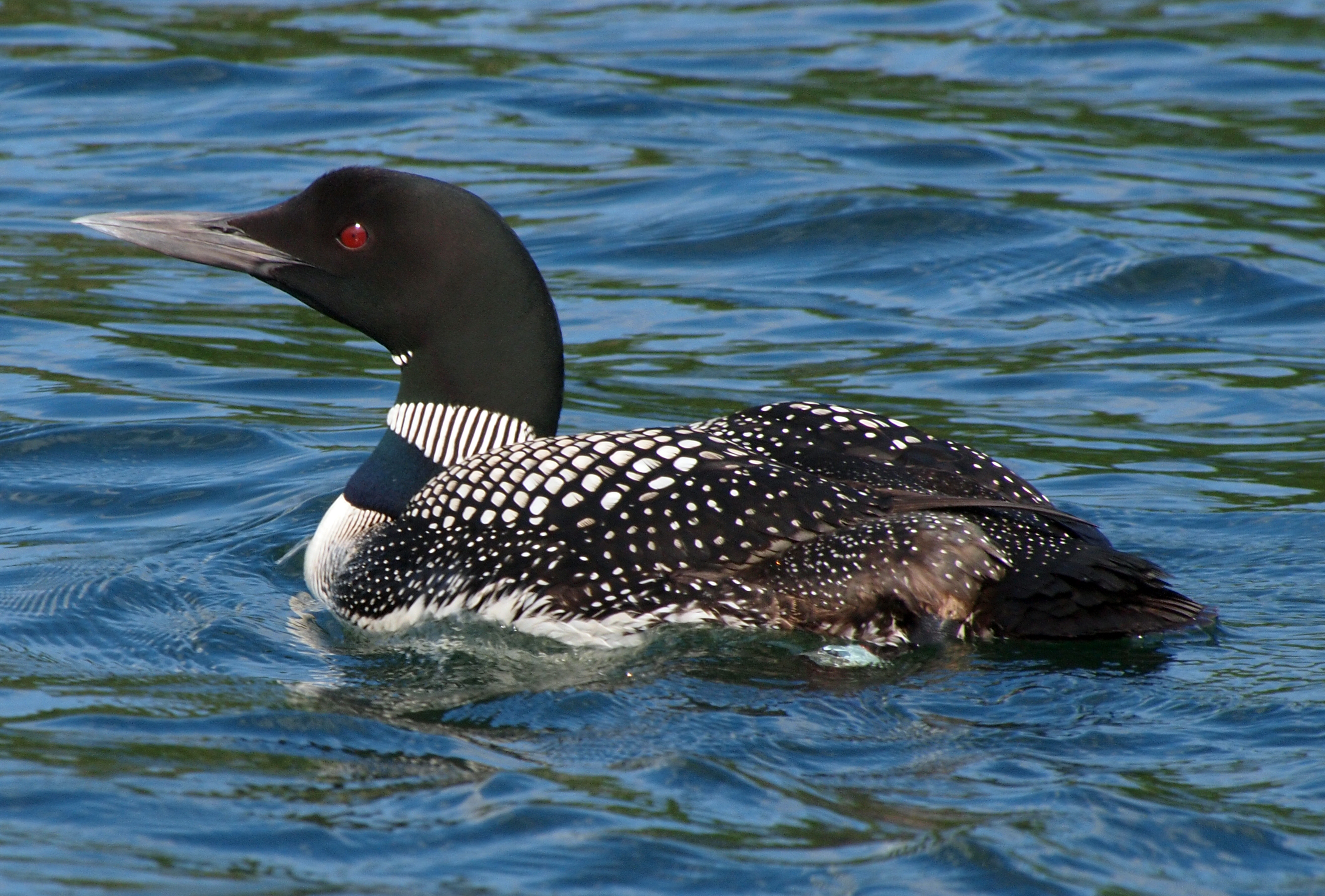
Great Northern Loon
ENEndangered

Great Northern Loon

Gavia immer

The common loon or great northern diver is a large member of the loon, or diver, family of birds. Breeding adults have a plumage that includes a broad black head and neck with a greenish, purplish, or bluish sheen, blackish or blackish-grey upperparts, and pure white underparts except some black on the undertail coverts and vent.

Photo: Wikimedia Commons (CC) via https://en.wikipedia.org/wiki/Common_loon

01Classification

Taxonomy & Classification

Kingdom

Animalia

Phylum

Chordata

Class

Aves

Order

Gaviiformes

Family

Gaviidae

Genus

Gavia

Great Northern Loon belongs to the family Gaviidae, order Gaviiformes, within the Aves class.

02Description

Species Profile

The common loon or great northern diver is a large member of the loon, or diver, family of birds. Breeding adults have a plumage that includes a broad black head and neck with a greenish, purplish, or bluish sheen, blackish or blackish-grey upperparts, and pure white underparts except some black on the undertail coverts and vent. Non-breeding adults are brownish with a dark neck and head marked with dark grey-brown. Their upperparts are dark brownish-grey with an unclear pattern of squares on the shoulders, and the underparts, lower face, chin, and throat are whitish. The sexes look alike, though males are significantly heavier than females. During the breeding season, loons live on lakes and other waterways in Canada, the northern United States, and southern parts of Greenland and...

Great Northern Loons face significant population declines primarily due to habitat loss from shoreline development and water level fluctuations that destroy nesting sites. Climate change is altering lake ecosystems and prey availability, while pollution from mercury, lead fishing tackle, and oil spills causes direct mortality and reproductive failure.

Key Facts

IUCN StatusEndangered (EN)
GroupBirds
03Habitat

Habitat & Distribution

Common loons are mainly Nearctic, and breed from 48° N to the Arctic Circle, locally south to 40° N and north to 78° N. Deep lakes with warm surface waters, relatively low biological productivity and low turbidity where their fish prey are easy to see are habitats where breeding loons are more successful in raising young. For protection from predators, common loons favour lakes with islands and...

FRESHWATERMajorMARINEMajorTERRESTRIALMajor
04Threats

Threats

!

IUCN Red List: Endangered

Great Northern Loons face significant population declines primarily due to habitat loss from shoreline development and water level fluctuations that destroy nesting sites. Climate change is altering lake ecosystems and prey availability, while pollution from mercury, lead fishing tackle, and oil spills causes direct mortality and reproductive failure.

Mercury and lead poisoning

HighOngoing

Shoreline development and human disturbance

HighOngoing

Water level fluctuations from dam operations

HighOngoing

Climate change impacts on lake ecosystems

MediumOngoing

Oil spills and marine pollution

MediumOngoing
07National Status

National vs Global Threat Status

How this species is assessed at the national level compared to its IUCN global status (EN).

CountryNational StatusGlobal StatusComparison
EULCLeast ConcernENEndangeredLower local risk

National Red List data sourced from the National Red List Project (nationalredlist.org, ZSL) and country-specific Red List authorities.

Community

Community Sightings

Report a sighting

No community sightings yet. Be the first to report!

07Sources

Sources & Attribution

How to Cite

IUCN: IUCN (2025). The IUCN Red List of Threatened Species. Version 2025-1. Available at: https://www.iucnredlist.org. doi:10.2305/IUCN.UK.2025-1.RLTS

GBIF: GBIF.org (2025). GBIF Home Page. Available at: https://www.gbif.org

National Red Lists: ZSL (2025). National Red List. Zoological Society of London. Available at: https://www.nationalredlist.org

This page: SpeciesRadar (2025). Great Northern Loon (Gavia immer). SpeciesRadar: Intelligence for Earth's Biodiversity. Available at: https://speciesradar.org/species/great-northern-loon

Full citation guide & data usage terms