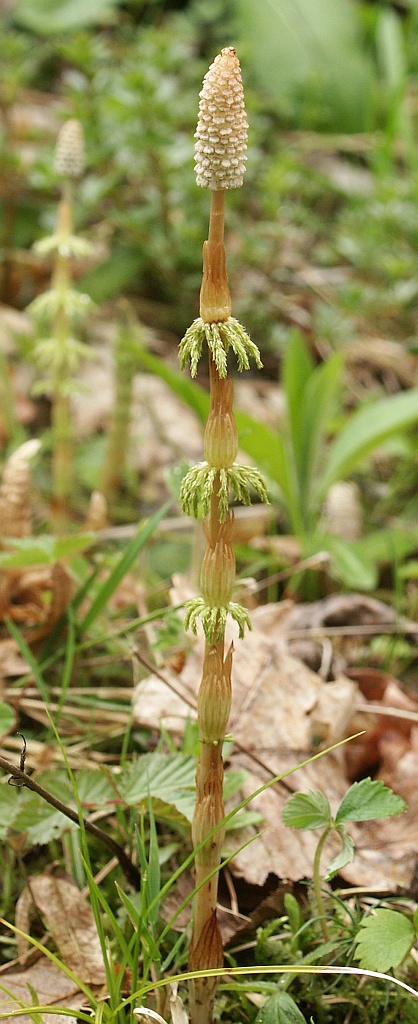
Great Horsetail
Equisetum telmateia
Equisetum telmateia, the great horsetail, is a species of Equisetum (horsetail) native to Europe, western Asia and northwest Africa. It was formerly widely treated in a broader sense including a subspecies in western North America, but this is now treated as a separate species, Equisetum braunii.
Photo: Wikimedia Commons (CC) via https://en.wikipedia.org/wiki/Equisetum_telmateia
Taxonomy & Classification
Kingdom
Plantae
Phylum
Tracheophyta
Class
Polypodiopsida
Order
Equisetales
Family
Equisetaceae
Genus
Equisetum
Great Horsetail belongs to the family Equisetaceae, order Equisetales, within the Polypodiopsida class.
Species Profile
Equisetum telmateia, the great horsetail, is a species of Equisetum (horsetail) native to Europe, western Asia and northwest Africa. It was formerly widely treated in a broader sense including a subspecies in western North America, but this is now treated as a separate species, Equisetum braunii.
Great Horsetail faces severe population declines due to widespread habitat destruction and degradation of its specialized wetland environments. Urban development, agricultural expansion, and water management practices have dramatically reduced suitable habitat, while climate change threatens the consistent moisture conditions this species requires for survival.
Key Facts
Habitat & Distribution
Great Horsetail inhabits permanently moist soils in wetlands, stream banks, ditches, seepage areas, and boggy ground, typically in partially shaded locations with consistent groundwater supply. The species requires calcium-rich, alkaline soils and is often found in fens, wet meadows, and along springs where water emerges from underground sources.
Threats
IUCN Red List: Critically Endangered
Great Horsetail faces severe population declines due to widespread habitat destruction and degradation of its specialized wetland environments. Urban development, agricultural expansion, and water management practices have dramatically reduced suitable habitat, while climate change threatens the consistent moisture conditions this species requires for survival.
Agricultural conversion of riparian areas
Climate change affecting moisture regimes
Urban development and infrastructure expansion
Water table alteration and hydrological changes
Wetland habitat destruction and drainage
National vs Global Threat Status
How this species is assessed at the national level compared to its IUCN global status (CR).
| Country | National Status | Global Status | Comparison |
|---|---|---|---|
| EU | LCLeast Concern | CRCritically Endangered | Lower local risk |
| EU | LCLeast Concern | CRCritically Endangered | Lower local risk |
| EU | LCLeast Concern | CRCritically Endangered | Lower local risk |
| EU | LCLeast Concern | CRCritically Endangered | Lower local risk |
National Red List data sourced from the National Red List Project (nationalredlist.org, ZSL) and country-specific Red List authorities.
Community Sightings
Report a sightingNo community sightings yet. Be the first to report!
Sources & Attribution
How to Cite
IUCN: IUCN (2025). The IUCN Red List of Threatened Species. Version 2025-1. Available at: https://www.iucnredlist.org. doi:10.2305/IUCN.UK.2025-1.RLTS
GBIF: GBIF.org (2025). GBIF Home Page. Available at: https://www.gbif.org
National Red Lists: ZSL (2025). National Red List. Zoological Society of London. Available at: https://www.nationalredlist.org
This page: SpeciesRadar (2025). Great Horsetail (Equisetum telmateia). SpeciesRadar: Intelligence for Earth's Biodiversity. Available at: https://speciesradar.org/species/great-horsetail