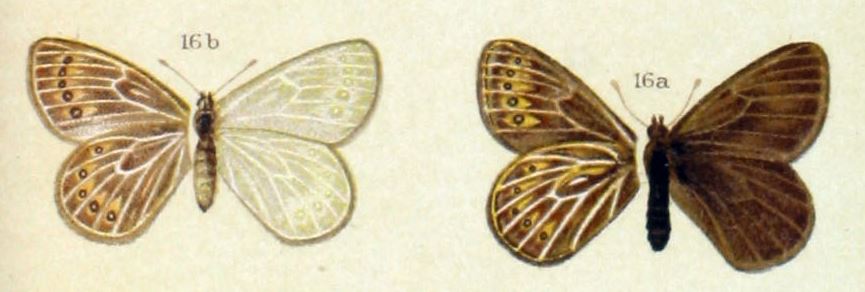
Glanville Fritillary
Melitaea cinxia
The Glanville fritillary is a butterfly of the family Nymphalidae. It is named for Eleanor Glanville, the naturalist who discovered it, and the checkerboard pattern on its wings.
Photo: Wikimedia Commons (CC) via https://en.wikipedia.org/wiki/Glanville_fritillary
Taxonomy & Classification
Kingdom
Animalia
Phylum
Arthropoda
Class
Insecta
Order
Lepidoptera
Family
Nymphalidae
Genus
Melitaea
Glanville Fritillary belongs to the family Nymphalidae, order Lepidoptera, within the Insecta class.
Species Profile
The Glanville fritillary is a butterfly of the family Nymphalidae. It is named for Eleanor Glanville, the naturalist who discovered it, and the checkerboard pattern on its wings. These butterflies live in almost all of Europe, especially Finland, and in parts of northwest Africa. They are absent from the far north of Europe and parts of the Iberian Peninsula. To the east they are found across the Palearctic.
The Glanville Fritillary faces severe population declines primarily due to habitat loss and fragmentation of its specialized grassland ecosystems. Climate change and agricultural intensification have further reduced the availability of suitable breeding sites containing its host plant, ribwort plantain. Small, isolated populations are particularly vulnerable to local extinctions due to reduced genetic diversity and increased susceptibility to environmental stochasticity.
Key Facts
Habitat & Distribution
The Glanville fritillary is found across Europe and temperate Asia. It is most commonly found on Åland (Finland), which host a network of about 4,000 dry meadows, the fritillary's ideal habitat. These butterflies commonly inhabit open grassland at an elevation of above sea level.
Threats
IUCN Red List: Critically Endangered
The Glanville Fritillary faces severe population declines primarily due to habitat loss and fragmentation of its specialized grassland ecosystems. Climate change and agricultural intensification have further reduced the availability of suitable breeding sites containing its host plant, ribwort plantain. Small, isolated populations are particularly vulnerable to local extinctions due to reduced genetic diversity and increased susceptibility to environmental stochasticity.
Agricultural intensification
Climate change
Habitat loss and fragmentation
Loss of host plant availability
Small population effects and genetic bottlenecks
National vs Global Threat Status
How this species is assessed at the national level compared to its IUCN global status (CR).
| Country | National Status | Global Status | Comparison |
|---|---|---|---|
| EU | LCLeast Concern | CRCritically Endangered | Lower local risk |
| EU | LCLeast Concern | CRCritically Endangered | Lower local risk |
National Red List data sourced from the National Red List Project (nationalredlist.org, ZSL) and country-specific Red List authorities.
Community Sightings
Report a sightingNo community sightings yet. Be the first to report!
Sources & Attribution
How to Cite
IUCN: IUCN (2025). The IUCN Red List of Threatened Species. Version 2025-1. Available at: https://www.iucnredlist.org. doi:10.2305/IUCN.UK.2025-1.RLTS
GBIF: GBIF.org (2025). GBIF Home Page. Available at: https://www.gbif.org
National Red Lists: ZSL (2025). National Red List. Zoological Society of London. Available at: https://www.nationalredlist.org
This page: SpeciesRadar (2025). Glanville Fritillary (Melitaea cinxia). SpeciesRadar: Intelligence for Earth's Biodiversity. Available at: https://speciesradar.org/species/glanville-fritillary