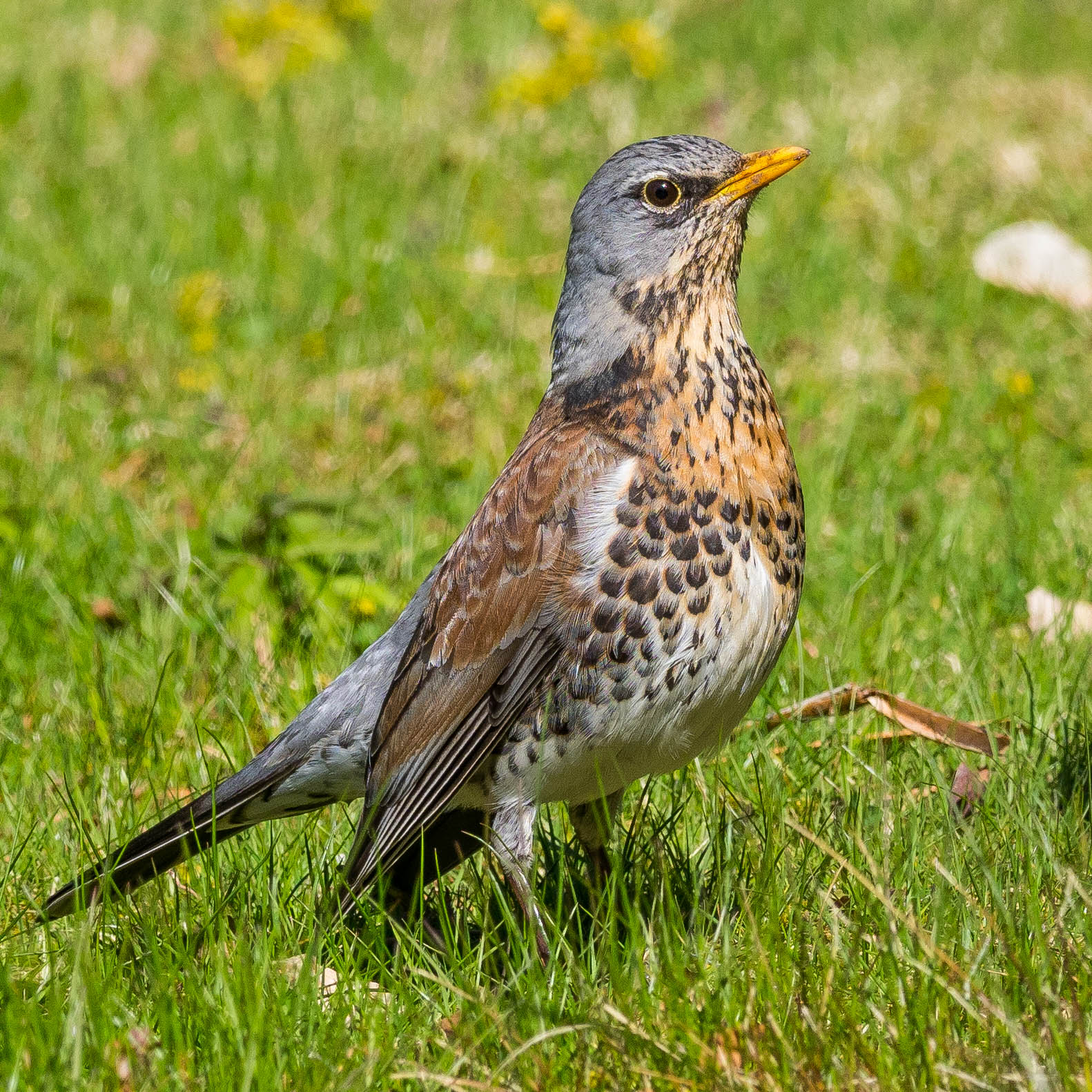
Fieldfare
ENEndangered

Fieldfare

Turdus pilaris

The fieldfare is a member of the thrush family Turdidae. It breeds in woodland and scrub in northern Europe and across the Palearctic.

Photo: Wikimedia Commons (CC) via https://en.wikipedia.org/wiki/Fieldfare

01Classification

Taxonomy & Classification

Kingdom

Animalia

Phylum

Chordata

Class

Aves

Order

Passeriformes

Family

Turdidae

Genus

Turdus

Fieldfare belongs to the family Turdidae, order Passeriformes, within the Aves class.

02Description

Species Profile

The fieldfare is a member of the thrush family Turdidae. It breeds in woodland and scrub in northern Europe and across the Palearctic. It is strongly migratory, with many northern birds moving south during the winter. It is a very rare breeder in the British Isles, but winters in large numbers in the United Kingdom, Southern Europe, North Africa and the Middle East. It is omnivorous, eating a wide range of molluscs, insects and earthworms in the summer, and berries, grain and seeds in the winter.

The Fieldfare is experiencing population declines primarily due to agricultural intensification and habitat loss across its breeding and wintering ranges. Climate change is altering the timing of food availability and weather patterns, while urbanization continues to fragment suitable habitat.

Key Facts

IUCN StatusEndangered (EN)
GroupBirds
03Habitat

Habitat & Distribution

Fieldfares in winter The fieldfare is a migratory species with a palearctic distribution. It breeds in northern Norway, northern Sweden, Finland, Belgium, Germany, Switzerland, Austria, the Czech Republic, Slovakia, Hungary, Poland and Siberia as far east as Transbaikal, the Aldan River and the Tian Shan Mountains in North West China. Its winter range extends through western and southern Europe...

TERRESTRIALMajor
04Threats

Threats

!

IUCN Red List: Endangered

The Fieldfare is experiencing population declines primarily due to agricultural intensification and habitat loss across its breeding and wintering ranges. Climate change is altering the timing of food availability and weather patterns, while urbanization continues to fragment suitable habitat.

Agricultural intensification and loss of traditional farming practices

HighOngoing

Habitat fragmentation and loss of woodland edges

HighOngoing

Changes in winter food sources and foraging areas

MediumOngoing

Climate change affecting food availability and breeding timing

MediumOngoing

Urbanization and development pressure

MediumOngoing
07National Status

National vs Global Threat Status

How this species is assessed at the national level compared to its IUCN global status (EN).

CountryNational StatusGlobal StatusComparison
EULCLeast ConcernENEndangeredLower local risk

National Red List data sourced from the National Red List Project (nationalredlist.org, ZSL) and country-specific Red List authorities.

Community

Community Sightings

Report a sighting

No community sightings yet. Be the first to report!

07Sources

Sources & Attribution

How to Cite

IUCN: IUCN (2025). The IUCN Red List of Threatened Species. Version 2025-1. Available at: https://www.iucnredlist.org. doi:10.2305/IUCN.UK.2025-1.RLTS

GBIF: GBIF.org (2025). GBIF Home Page. Available at: https://www.gbif.org

National Red Lists: ZSL (2025). National Red List. Zoological Society of London. Available at: https://www.nationalredlist.org

This page: SpeciesRadar (2025). Fieldfare (Turdus pilaris). SpeciesRadar: Intelligence for Earth's Biodiversity. Available at: https://speciesradar.org/species/fieldfare

Full citation guide & data usage terms