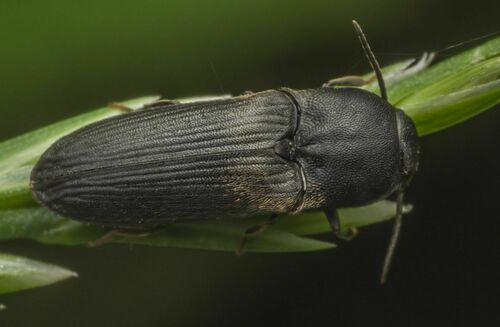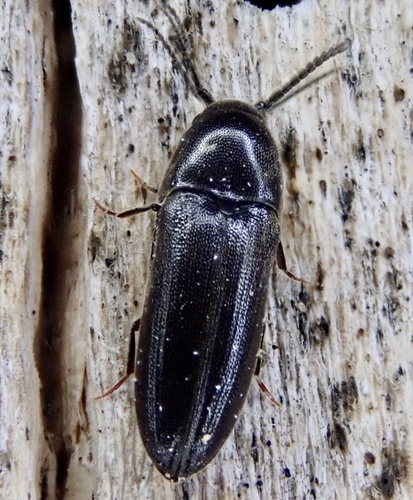
False click beetle
Eucnemis capucina
The False click beetle (Eucnemis capucina) is a small, elongated beetle species with a distinctive reddish-brown to dark brown coloration and characteristic click mechanism that allows it to right itself when overturned. This saproxylic species plays a crucial ecological role as a decomposer, with its larvae developing within decaying hardwood, particularly in the fungal-softened wood of ancient trees.
Taxonomy & Classification
Kingdom
Animalia
Phylum
Arthropoda
Class
Insecta
Order
Coleoptera
Family
Eucnemidae
Genus
Eucnemis
False click beetle belongs to the family Eucnemidae, order Coleoptera, within the Insecta class.
Species Profile
The False click beetle (Eucnemis capucina) is a small, elongated beetle species with a distinctive reddish-brown to dark brown coloration and characteristic click mechanism that allows it to right itself when overturned. This saproxylic species plays a crucial ecological role as a decomposer, with its larvae developing within decaying hardwood, particularly in the fungal-softened wood of ancient trees.
The False click beetle (Eucnemis capucina) is critically endangered primarily due to the loss and degradation of its specialized habitat requirements in old-growth forests. This species depends on ancient woodland with specific deadwood characteristics, particularly old beech and oak trees with fungal decay, which have become increasingly rare due to intensive forest management and habitat fragmentation.
Key Facts
Habitat & Distribution
Eucnemis capucina inhabits mature deciduous and mixed forests, specifically requiring ancient trees with extensive areas of fungal decay, particularly in beech, oak, and other broadleaved species. The species is dependent on the complex microhabitat created by wood-decay fungi within hollow trunks and large dead branches of veteran trees.
Threats
IUCN Red List: Critically Endangered
The False click beetle (Eucnemis capucina) is critically endangered primarily due to the loss and degradation of its specialized habitat requirements in old-growth forests. This species depends on ancient woodland with specific deadwood characteristics, particularly old beech and oak trees with fungal decay, which have become increasingly rare due to intensive forest management and habitat fragmentation.
Intensive forest management practices
Loss of old-growth forest habitat
Removal of deadwood and fallen timber
Climate change affecting forest composition
Habitat fragmentation
National vs Global Threat Status
How this species is assessed at the national level compared to its IUCN global status (CR).
| Country | National Status | Global Status | Comparison |
|---|---|---|---|
| EU | LCLeast Concern | CRCritically Endangered | Lower local risk |
| EU | LCLeast Concern | CRCritically Endangered | Lower local risk |
National Red List data sourced from the National Red List Project (nationalredlist.org, ZSL) and country-specific Red List authorities.
Community Sightings
Report a sightingNo community sightings yet. Be the first to report!
Sources & Attribution
How to Cite
IUCN: IUCN (2025). The IUCN Red List of Threatened Species. Version 2025-1. Available at: https://www.iucnredlist.org. doi:10.2305/IUCN.UK.2025-1.RLTS
GBIF: GBIF.org (2025). GBIF Home Page. Available at: https://www.gbif.org
National Red Lists: ZSL (2025). National Red List. Zoological Society of London. Available at: https://www.nationalredlist.org
This page: SpeciesRadar (2025). False click beetle (Eucnemis capucina). SpeciesRadar: Intelligence for Earth's Biodiversity. Available at: https://speciesradar.org/species/false-click-beetle