
Elm Leech
Hypsizygus ulmarius
Photo: Wikimedia Commons (CC) via https://en.wikipedia.org/wiki/Hypsizygus_ulmarius
Overview
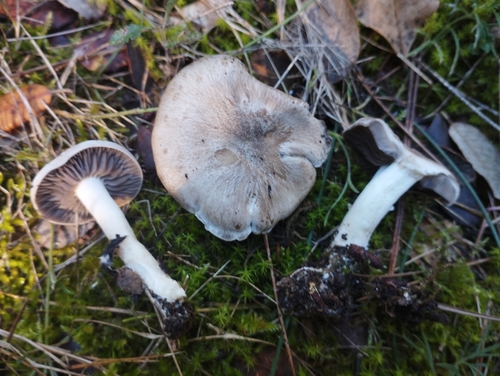
Hypsizygus ulmarius, also known as the elm oyster mushroom, and less commonly as the elm leech. It has often been confused with oyster mushrooms in the Pleurotus genus but can be differentiated easily as the gills are either not decurrent or not deeply decurrent.
The Elm Oyster mushroom (Hypsizygus ulmarius) faces severe decline primarily due to the widespread loss of its host trees, particularly elm species, which have been devastated by Dutch elm disease across much of its range. Habitat fragmentation and the removal of dead and dying trees for disease management have further reduced available substrate for this saprobic fungus. Climate change may also be altering the environmental conditions necessary for successful fruiting and spore dispersal.
Habitat
H. ulmarius cultured on hay-infused agar (left) and potato dextrose agar (right) after five days of growth at room temperature
The H. ulmarius mushroom commonly grows on tree species like elm, box elder (Acer negundo), and beech, though it may be found on other trees as well. The fungus accomplishes this by using a complex suite of enzymes that dissolve both cellulose and lignin like laccase. It...
Other threatened species in Lyophyllaceae
Frequently asked questions
Why is Elm Leech classified as Critically Endangered?
Where does Elm Leech live?
What are the main threats to Elm Leech?
Get weekly conservation intelligence
One short digest a week of the most striking species and country data we ship, plus breaking conservation news paired with our database where it matters.
Free, no spam. One-click unsubscribe in every email.