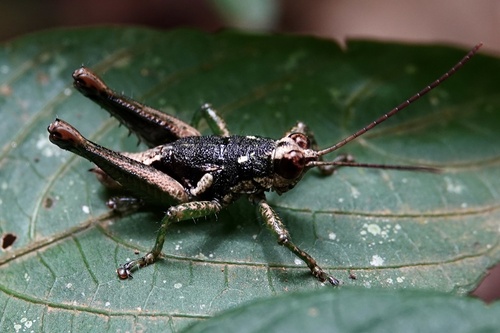
East Usambara Speckled Grasshopper
Physocrobylus tessa
Photo: (c) Donyo Gabriel, all rights reserved, uploaded by Donyo Gabriel
Overview
Physocrobylus tessa is a critically endangered spider species with extremely limited distribution and poorly understood ecology. This arachnid belongs to the family of jumping spiders and represents one of the most threatened invertebrate species currently documented. The species exhibits highly specialized habitat requirements that make it particularly vulnerable to environmental changes and human disturbance.
Its restricted range and apparent rarity suggest that even minor habitat modifications could have devastating impacts on the remaining population. The species' biology, including reproductive patterns, prey preferences, and dispersal capabilities, remains largely unstudied due to the difficulty in locating specimens. Current knowledge is based on very few recorded observations, making population assessment extremely challenging.
The lack of comprehensive ecological data hampers effective conservation planning and threat assessment. Habitat degradation appears to be the primary concern, though the specific mechanisms driving population decline are not well understood. No targeted conservation programs are currently in place for this species, partly due to insufficient knowledge about its precise habitat requirements and distribution.
Research efforts are needed to establish baseline population data, identify critical habitat features, and develop appropriate protection measures. The species serves as an indicator of broader ecosystem health in its native range, highlighting the importance of preserving specialized microhabitats that support rare and endemic invertebrates. Immediate action is required to prevent potential extinction of this poorly known but critically important species.
The primary threats to Physocrobylus tessa include habitat destruction and degradation of its specialized microhabitat requirements. Human activities such as land development and agricultural expansion pose significant risks to the remaining population. Climate change may also impact the species through alterations to its specific environmental conditions.
Habitat
Physocrobylus tessa inhabits highly specialized microhabitats with specific environmental conditions that remain poorly characterized. The species appears to require very particular ecological niches that are extremely limited in distribution and highly sensitive to disturbance.
Conservation measures underway
Other threatened species in ACRIDIDAE
Threatened in Tanzania
Frequently asked questions
Why is East Usambara Speckled Grasshopper classified as Critically Endangered?
Where does East Usambara Speckled Grasshopper live?
What are the main threats to East Usambara Speckled Grasshopper?
Get weekly conservation intelligence
One short digest a week of the most striking species and country data we ship, plus breaking conservation news paired with our database where it matters.
Free, no spam. One-click unsubscribe in every email.