diknerfkribbenmos
Cinclidotus danubicus
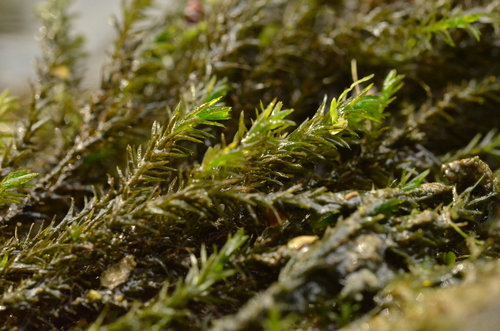
Cinclidotus danubicus is a rare aquatic moss species with distinctive dark green to brownish cushion-like growth forms that create dense, ribbed mats along rocky substrates. This specialized bryophyte plays a crucial role in stabilizing riverbank sediments and providing microhabitat for invertebrate communities in fast-flowing water systems.
Photo: iNaturalist: (c) petit_bonnier, some rights reserved (CC BY-NC)
Taxonomy & Classification
Kingdom
Plantae
Phylum
Bryophyta
Class
Bryopsida
Order
Pottiales
Family
Pottiaceae
Genus
Cinclidotus
diknerfkribbenmos belongs to the family Pottiaceae, order Pottiales, within the Bryopsida class.
Species Profile
Cinclidotus danubicus is a rare aquatic moss species with distinctive dark green to brownish cushion-like growth forms that create dense, ribbed mats along rocky substrates. This specialized bryophyte plays a crucial role in stabilizing riverbank sediments and providing microhabitat for invertebrate communities in fast-flowing water systems.
Cinclidotus danubicus, a moss species endemic to the Danube River basin, faces severe decline due to habitat degradation from river regulation and pollution. Dam construction and channelization have dramatically altered the natural flow regimes and substrate conditions essential for this aquatic moss. Water quality deterioration from agricultural runoff and industrial pollution further threatens the remaining populations.
Key Facts
Habitat & Distribution
This moss is restricted to submerged and periodically exposed rocks in fast-flowing, calcium-rich rivers and streams with high water quality. It typically colonizes limestone or calcareous bedrock in montane and submontane river systems where water levels fluctuate seasonally.
Threats
IUCN Red List: Critically Endangered
Cinclidotus danubicus, a moss species endemic to the Danube River basin, faces severe decline due to habitat degradation from river regulation and pollution. Dam construction and channelization have dramatically altered the natural flow regimes and substrate conditions essential for this aquatic moss. Water quality deterioration from agricultural runoff and industrial pollution further threatens the remaining populations.
Habitat fragmentation due to channelization
River regulation and dam construction
Water pollution from agricultural and industrial sources
Climate change affecting water flow patterns
Invasive species competition
National vs Global Threat Status
How this species is assessed at the national level compared to its IUCN global status (CR).
| Country | National Status | Global Status | Comparison |
|---|---|---|---|
| EU | LCLeast Concern | CRCritically Endangered | Lower local risk |
| EU | LCLeast Concern | CRCritically Endangered | Lower local risk |
National Red List data sourced from the National Red List Project (nationalredlist.org, ZSL) and country-specific Red List authorities.
Community Sightings
Report a sightingNo community sightings yet. Be the first to report!
Sources & Attribution
How to Cite
IUCN: IUCN (2025). The IUCN Red List of Threatened Species. Version 2025-1. Available at: https://www.iucnredlist.org. doi:10.2305/IUCN.UK.2025-1.RLTS
GBIF: GBIF.org (2025). GBIF Home Page. Available at: https://www.gbif.org
National Red Lists: ZSL (2025). National Red List. Zoological Society of London. Available at: https://www.nationalredlist.org
This page: SpeciesRadar (2025). diknerfkribbenmos (Cinclidotus danubicus). SpeciesRadar: Intelligence for Earth's Biodiversity. Available at: https://speciesradar.org/species/diknerfkribbenmos