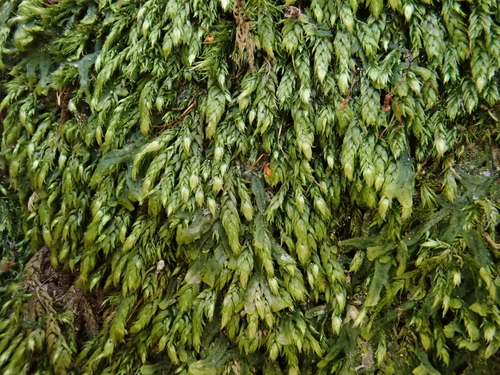
Depressed Feather-moss
Taxiphyllum wissgrillii
Depressed Feather-moss (Taxiphyllum wissgrillii) is a small, delicate bryophyte characterized by its flattened, feather-like branching pattern and distinctive depressed growth form that hugs closely to substrate surfaces. This moss species plays a crucial ecological role in maintaining microhabitat moisture levels and providing shelter for invertebrates in specialized forest ecosystems.
Photo: iNaturalist: (c) Christian Berg, some rights reserved (CC BY), uploaded by Christian Berg
Taxonomy & Classification
Kingdom
Plantae
Phylum
Bryophyta
Class
Bryopsida
Order
Hypnales
Family
Taxiphyllaceae
Genus
Taxiphyllum
Depressed Feather-moss belongs to the family Taxiphyllaceae, order Hypnales, within the Bryopsida class.
Species Profile
Depressed Feather-moss (Taxiphyllum wissgrillii) is a small, delicate bryophyte characterized by its flattened, feather-like branching pattern and distinctive depressed growth form that hugs closely to substrate surfaces. This moss species plays a crucial ecological role in maintaining microhabitat moisture levels and providing shelter for invertebrates in specialized forest ecosystems.
Depressed Feather-moss (Taxiphyllum wissgrillii) is critically endangered due to its extremely limited distribution and vulnerability to habitat degradation. The species faces severe threats from human activities that alter its specialized microhabitat requirements in moist, shaded environments. Climate change and increased frequency of disturbance events further compound the risk of extinction for this rare bryophyte.
Key Facts
Habitat & Distribution
This moss inhabits the humid understory of old-growth temperate forests, typically growing on decaying logs, tree bases, and shaded rock surfaces where consistent moisture and low light conditions prevail. It requires stable forest microclimates with high humidity and minimal temperature fluctuations.
Threats
IUCN Red List: Critically Endangered
Depressed Feather-moss (Taxiphyllum wissgrillii) is critically endangered due to its extremely limited distribution and vulnerability to habitat degradation. The species faces severe threats from human activities that alter its specialized microhabitat requirements in moist, shaded environments. Climate change and increased frequency of disturbance events further compound the risk of extinction for this rare bryophyte.
Climate change and altered moisture regimes
Extremely small population size
Habitat loss and degradation
Human disturbance and trampling
Limited dispersal ability
National vs Global Threat Status
How this species is assessed at the national level compared to its IUCN global status (CR).
| Country | National Status | Global Status | Comparison |
|---|---|---|---|
| EU | LCLeast Concern | CRCritically Endangered | Lower local risk |
| EU | LCLeast Concern | CRCritically Endangered | Lower local risk |
National Red List data sourced from the National Red List Project (nationalredlist.org, ZSL) and country-specific Red List authorities.
Community Sightings
Report a sightingNo community sightings yet. Be the first to report!
Sources & Attribution
How to Cite
IUCN: IUCN (2025). The IUCN Red List of Threatened Species. Version 2025-1. Available at: https://www.iucnredlist.org. doi:10.2305/IUCN.UK.2025-1.RLTS
GBIF: GBIF.org (2025). GBIF Home Page. Available at: https://www.gbif.org
National Red Lists: ZSL (2025). National Red List. Zoological Society of London. Available at: https://www.nationalredlist.org
This page: SpeciesRadar (2025). Depressed Feather-moss (Taxiphyllum wissgrillii). SpeciesRadar: Intelligence for Earth's Biodiversity. Available at: https://speciesradar.org/species/depressed-feather-moss