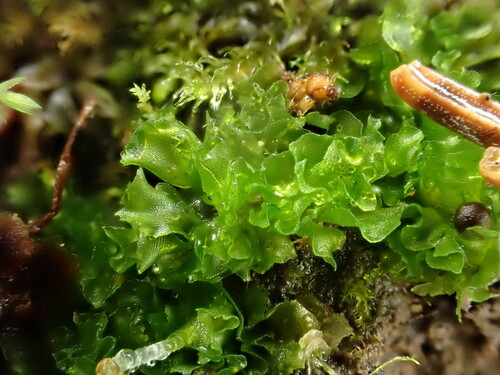
Common Frillwort
Fossombronia pusilla
Common Frillwort (Fossombronia pusilla) is a tiny leafy liverwort with distinctive frilled, translucent leaves that form small rosettes or patches on soil surfaces. This diminutive bryophyte plays an important ecological role as a pioneer species, helping to stabilize soil and create microhabitats for other small organisms in early successional environments.
Photo: iNaturalist: (c) Stefan Gey, some rights reserved (CC BY-NC), uploaded by Stefan Gey
Taxonomy & Classification
Kingdom
Plantae
Phylum
Marchantiophyta
Class
Jungermanniopsida
Order
Fossombroniales
Family
Fossombroniaceae
Genus
Fossombronia
Common Frillwort belongs to the family Fossombroniaceae, order Fossombroniales, within the Jungermanniopsida class.
Species Profile
Common Frillwort (Fossombronia pusilla) is a tiny leafy liverwort with distinctive frilled, translucent leaves that form small rosettes or patches on soil surfaces. This diminutive bryophyte plays an important ecological role as a pioneer species, helping to stabilize soil and create microhabitats for other small organisms in early successional environments.
Common Frillwort (Fossombronia pusilla) faces severe decline due to habitat loss and degradation of its specialized wetland environments. This small liverwort is particularly vulnerable to changes in water quality, hydrological patterns, and human disturbance of its ephemeral pool and marsh habitats.
Key Facts
Habitat & Distribution
Common Frillwort grows on bare, disturbed clay and sandy soils along field margins, footpaths, and recently cleared areas. It thrives in locations with seasonal moisture fluctuations, particularly on compacted earth that remains damp during winter and spring months.
Threats
IUCN Red List: Critically Endangered
Common Frillwort (Fossombronia pusilla) faces severe decline due to habitat loss and degradation of its specialized wetland environments. This small liverwort is particularly vulnerable to changes in water quality, hydrological patterns, and human disturbance of its ephemeral pool and marsh habitats.
Habitat loss and fragmentation
Hydrological changes and water level fluctuations
Water pollution and eutrophication
Agricultural intensification
Climate change impacts on wetland systems
National vs Global Threat Status
How this species is assessed at the national level compared to its IUCN global status (CR).
| Country | National Status | Global Status | Comparison |
|---|---|---|---|
| EU | LCLeast Concern | CRCritically Endangered | Lower local risk |
| EU | LCLeast Concern | CRCritically Endangered | Lower local risk |
National Red List data sourced from the National Red List Project (nationalredlist.org, ZSL) and country-specific Red List authorities.
Community Sightings
Report a sightingNo community sightings yet. Be the first to report!
Sources & Attribution
How to Cite
IUCN: IUCN (2025). The IUCN Red List of Threatened Species. Version 2025-1. Available at: https://www.iucnredlist.org. doi:10.2305/IUCN.UK.2025-1.RLTS
GBIF: GBIF.org (2025). GBIF Home Page. Available at: https://www.gbif.org
National Red Lists: ZSL (2025). National Red List. Zoological Society of London. Available at: https://www.nationalredlist.org
This page: SpeciesRadar (2025). Common Frillwort (Fossombronia pusilla). SpeciesRadar: Intelligence for Earth's Biodiversity. Available at: https://speciesradar.org/species/common-frillwort