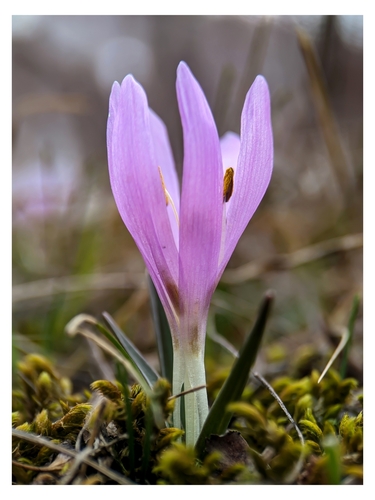
Greuter's Colchicum
Colchicum greuteri
Photo: Photo: (c) No Facei_i, some rights reserved (CC BY-NC), uploaded by No Facei_i
Overview
Greuter's Colchicum (Colchicum greuteri) is a perennial bulb-forming plant in the family Colchicaceae, recognized by its slender, strap-shaped leaves and delicate pale lilac to pink goblet-shaped flowers that emerge close to the ground, often ahead of or alongside its foliage. This autumn-flowering geophyte is native to a narrow range within the eastern Mediterranean, where it grows in rocky, calcareous slopes and open woodland margins at specific elevation bands suited to its seasonal growth cycle. Colchicum greuteri is classified as Critically Endangered (CR) by the IUCN, with a population trend that continues to decrease.
Its extreme rarity stems from a highly restricted distribution, believed to encompass only a handful of known localities, making it acutely vulnerable to any single damaging event or ongoing habitat pressure. Threats include land conversion for agriculture and grazing, encroachment from development, and illegal collection by bulb enthusiasts drawn to rare Colchicum species for horticultural trade. Small population size further limits genetic diversity and resilience to environmental change, compounding the risks posed by human activity.
Conservation attention has grown in recent years, with botanical institutions and regional herbaria working to document surviving populations and assess the species' precise ecological requirements, a necessary foundation for any future protective measures. Encouragingly, increased taxonomic and field survey interest in Mediterranean Colchicum species has brought renewed scientific focus to plants like C. greuteri that were previously overlooked, improving the prospects for targeted conservation action such as site protection and ex situ seed banking.
Continued monitoring of its few known sites, alongside collaboration between local authorities and botanical gardens, offers a meaningful path toward stabilizing this critically endangered species before further decline occurs.
Colchicum greuteri faces severe threats from habitat destruction due to agricultural expansion and urban development in its limited Mediterranean range. The species' extremely restricted distribution makes it particularly vulnerable to localized disturbances, while overgrazing by livestock degrades the specialized grassland habitats it requires. Climate change poses an additional threat through altered precipitation patterns that could disrupt the species' precise flowering and dormancy cycles.
Habitat
Colchicum greuteri inhabits Mediterranean grasslands, rocky slopes, and open woodlands at moderate elevations. The species typically grows in well-drained soils among sparse vegetation, often in areas with seasonal moisture patterns that support its autumn flowering cycle.
Conservation measures underway
Other threatened species in COLCHICACEAE
Threatened in Armenia


Frequently asked questions
Why is Greuter's Colchicum classified as Critically Endangered?
Where does Greuter's Colchicum live?
What are the main threats to Greuter's Colchicum?
Get weekly conservation intelligence
One short digest a week of the most striking species and country data we ship, plus breaking conservation news paired with our database where it matters.
Free, no spam. One-click unsubscribe in every email.