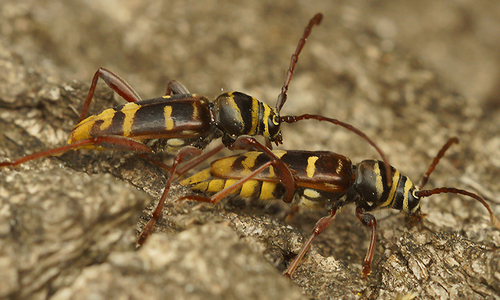
Clyte frelon
Plagionotus detritus
Clyte frelon (Plagionotus detritus) is a large longhorn beetle species characterized by its distinctive yellow and black banded pattern and robust build. Adults feed on flower nectar and pollen while their larvae develop within the wood of specific deciduous trees, playing a crucial role as both pollinators and wood decomposers in forest ecosystems.
Photo: iNaturalist: (c) Henk Wallays, all rights reserved
Taxonomy & Classification
Kingdom
Animalia
Phylum
Arthropoda
Class
Insecta
Order
Coleoptera
Family
Cerambycidae
Genus
Plagionotus
Clyte frelon belongs to the family Cerambycidae, order Coleoptera, within the Insecta class.
Species Profile
Clyte frelon (Plagionotus detritus) is a large longhorn beetle species characterized by its distinctive yellow and black banded pattern and robust build. Adults feed on flower nectar and pollen while their larvae develop within the wood of specific deciduous trees, playing a crucial role as both pollinators and wood decomposers in forest ecosystems.
Plagionotus detritus faces severe population decline primarily due to habitat loss from deforestation and urbanization of its native forest ecosystems. The species' dependence on specific host tree species makes it particularly vulnerable to forest fragmentation and degradation. Climate change may further exacerbate these pressures by altering the distribution and health of its required host plants.
Key Facts
Habitat & Distribution
The species inhabits mature deciduous and mixed forests, particularly those containing oak, beech, and maple trees. Adults are typically found on flowering shrubs and trees within forest clearings and edges, while larvae require dead or weakened hardwood trees for development.
Threats
IUCN Red List: Critically Endangered
Plagionotus detritus faces severe population decline primarily due to habitat loss from deforestation and urbanization of its native forest ecosystems. The species' dependence on specific host tree species makes it particularly vulnerable to forest fragmentation and degradation. Climate change may further exacerbate these pressures by altering the distribution and health of its required host plants.
Forest fragmentation
Habitat loss and deforestation
Loss of host tree species
Climate change impacts on forest ecosystems
Urbanization and development
National vs Global Threat Status
How this species is assessed at the national level compared to its IUCN global status (CR).
| Country | National Status | Global Status | Comparison |
|---|---|---|---|
| EU | LCLeast Concern | CRCritically Endangered | Lower local risk |
| EU | LCLeast Concern | CRCritically Endangered | Lower local risk |
National Red List data sourced from the National Red List Project (nationalredlist.org, ZSL) and country-specific Red List authorities.
Community Sightings
Report a sightingNo community sightings yet. Be the first to report!
Sources & Attribution
How to Cite
IUCN: IUCN (2025). The IUCN Red List of Threatened Species. Version 2025-1. Available at: https://www.iucnredlist.org. doi:10.2305/IUCN.UK.2025-1.RLTS
GBIF: GBIF.org (2025). GBIF Home Page. Available at: https://www.gbif.org
National Red Lists: ZSL (2025). National Red List. Zoological Society of London. Available at: https://www.nationalredlist.org
This page: SpeciesRadar (2025). Clyte frelon (Plagionotus detritus). SpeciesRadar: Intelligence for Earth's Biodiversity. Available at: https://speciesradar.org/species/clyte-frelon