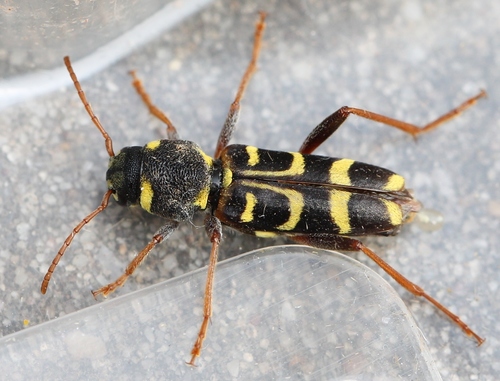
Xylotrechus arvicola
CRCritically Endangered

Xylotrechus arvicola

Local name: Clyte apaisé

Clyte apaisé (Xylotrechus arvicola) is a longhorn beetle species characterized by its distinctive black and yellow banded pattern across its elongated body and antennae. As a wood-boring beetle, it plays a crucial ecological role in forest ecosystems by decomposing dead and dying hardwood trees, particularly oak and beech species.

Photo: iNaturalist: (c) Marie Lou Legrand, some rights reserved (CC BY-NC), uploaded by Marie Lou Legrand

01Classification

Taxonomy & Classification

Kingdom

Animalia

Phylum

Arthropoda

Class

Insecta

Order

Coleoptera

Family

Cerambycidae

Genus

Xylotrechus

Xylotrechus arvicola belongs to the family Cerambycidae, order Coleoptera, within the Insecta class.

02Description

Species Profile

Clyte apaisé (Xylotrechus arvicola) is a longhorn beetle species characterized by its distinctive black and yellow banded pattern across its elongated body and antennae. As a wood-boring beetle, it plays a crucial ecological role in forest ecosystems by decomposing dead and dying hardwood trees, particularly oak and beech species. Adults are active during summer months and are important pollinators of various flowering plants in forest clearings.

Xylotrechus arvicola faces severe population decline primarily due to habitat loss from deforestation and agricultural expansion, which destroys the old-growth forests it depends on for breeding. The species is also threatened by climate change affecting its host tree species and collection pressure from entomologists due to its rarity.

Key Facts

IUCN StatusCritically Endangered (CR)
GroupInsects
03Habitat

Habitat & Distribution

Clyte apaisé inhabits mature deciduous forests with abundant dead and dying hardwood trees, particularly favoring oak-beech woodlands with natural clearings. The species requires forest edges and sun-dappled areas where adults can access flowering plants for nectar feeding while maintaining proximity to suitable breeding substrates.

04Threats

Threats

!

IUCN Red List: Critically Endangered

Xylotrechus arvicola faces severe population decline primarily due to habitat loss from deforestation and agricultural expansion, which destroys the old-growth forests it depends on for breeding. The species is also threatened by climate change affecting its host tree species and collection pressure from entomologists due to its rarity.

Agricultural expansion

HighOngoing

Deforestation and logging

HighOngoing

Habitat loss and fragmentation

HighOngoing

Climate change impacts on host trees

MediumOngoing

Over-collection by collectors

MediumOngoing
07National Status

National vs Global Threat Status

How this species is assessed at the national level compared to its IUCN global status (CR).

CountryNational StatusGlobal StatusComparison
EULCLeast ConcernCRCritically EndangeredLower local risk

National Red List data sourced from the National Red List Project (nationalredlist.org, ZSL) and country-specific Red List authorities.

Community

Community Sightings

Report a sighting

No community sightings yet. Be the first to report!

07Sources

Sources & Attribution

How to Cite

IUCN: IUCN (2025). The IUCN Red List of Threatened Species. Version 2025-1. Available at: https://www.iucnredlist.org. doi:10.2305/IUCN.UK.2025-1.RLTS

GBIF: GBIF.org (2025). GBIF Home Page. Available at: https://www.gbif.org

National Red Lists: ZSL (2025). National Red List. Zoological Society of London. Available at: https://www.nationalredlist.org

This page: SpeciesRadar (2025). Xylotrechus arvicola (Xylotrechus arvicola). SpeciesRadar: Intelligence for Earth's Biodiversity. Available at: https://speciesradar.org/species/clyte-apaise

Full citation guide & data usage terms