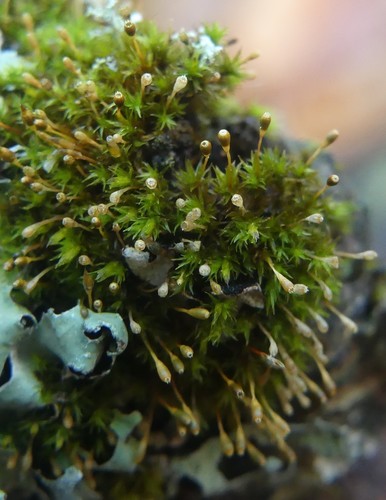
Club Pincushion
Ulota coarctata
Photo: iNaturalist: (c) Christian Grenier, some rights reserved (CC BY-NC), uploaded by Christian Grenier
Overview
Club Pincushion Moss (Ulota coarctata) is a small epiphytic moss species that forms distinctive cushion-like tufts on tree bark, particularly favoring deciduous trees. The moss is characterized by its club-shaped capsules that contract strongly when dry, giving it its common name, and its leaves that curl tightly inward during dry conditions. As an epiphyte, it plays an important ecological role in forest ecosystems by contributing to biodiversity, providing microhabitats for invertebrates, and participating in nutrient cycling.
Club Pincushion Moss faces significant threats from air pollution, particularly nitrogen deposition and sulfur compounds, which alter the chemical composition of its bark substrates and reduce population viability. Habitat loss through deforestation and urban development has fragmented populations, while climate change is shifting suitable habitat ranges and altering moisture regimes critical for this epiphytic species.
Habitat
Epiphytic moss species found on the bark of deciduous trees, particularly in mature woodlands, parklands, and tree-lined areas in temperate regions. Requires specific bark chemistry and moisture conditions, typically growing on smooth-barked trees such as ash, elm, and fruit trees.
Other threatened species in Orthotrichaceae
Frequently asked questions
Why is Club Pincushion classified as Vulnerable?
Where does Club Pincushion live?
What are the main threats to Club Pincushion?
Get weekly conservation intelligence
One short digest a week of the most striking species and country data we ship, plus breaking conservation news paired with our database where it matters.
Free, no spam. One-click unsubscribe in every email.