
Chestnut wrinkle-lichen
Cetraria sepincola
Photo: Wikimedia Commons (CC) via https://en.wikipedia.org/wiki/Cetraria_sepincola
Overview
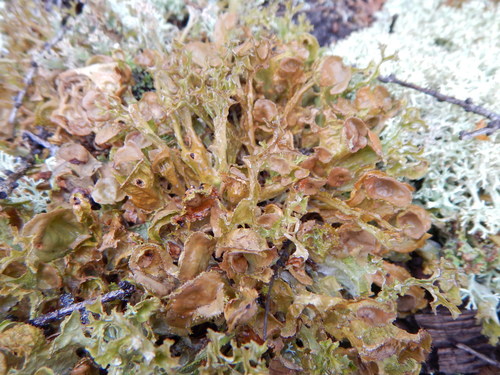
Cetraria sepincola, the chestnut wrinkle-lichen, is a species of foliose lichen in the family Parmeliaceae. It forms compact, cushion-like colonies typically 0.5–2 cm high, with a yellowish-green to dark brown upper surface and lighter underside. The species has a primarily circumboreal distribution and is widespread in northern regions, occurring from Alaska to northern California in North America and documented as far south as Argentina.
While mainly found growing on woody species like Betula, Sorbus, Salix, and Alnus in bog environments and open areas, it can occasionally be found on dead wood and rarely on rock surfaces. Originally described by Jakob Friedrich Ehrhart in 1783 as Lichen sepincola, it was transferred to the genus Cetraria by Erik Acharius in 1803.
Chestnut Wrinkle Lichen faces significant threats from air pollution, particularly nitrogen deposition and sulfur compounds, which alter its sensitive epiphytic habitat requirements. Climate change and habitat loss through deforestation and urban development further compromise the specific microclimate conditions this species requires on tree bark and wooden substrates.
Habitat
This epiphytic lichen grows primarily on the bark of deciduous and coniferous trees, as well as on wooden fences, posts, and other wooden substrates in open woodlands, forest edges, and semi-natural habitats. It requires specific humidity and air quality conditions typical of well-ventilated but sheltered environments.
Other threatened species in Parmeliaceae


Frequently asked questions
Why is Chestnut wrinkle-lichen classified as Vulnerable?
Where does Chestnut wrinkle-lichen live?
What are the main threats to Chestnut wrinkle-lichen?
Get weekly conservation intelligence
One short digest a week of the most striking species and country data we ship, plus breaking conservation news paired with our database where it matters.
Free, no spam. One-click unsubscribe in every email.