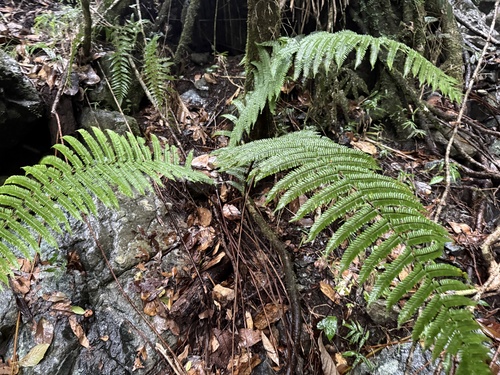
Brooks' alsophila
Alsophila brooksii
Photo: iNaturalist: (c) Omar Monzon Carmona, some rights reserved (CC BY-NC), uploaded by Omar Monzon Carmona
Overview
Alsophila brooksii, synonym Cyathea brooksii, is a species of tree fern native to Cuba, Hispaniola and Puerto Rico, where it grows on serpentine soils in shaded ravines, along streams, and on forested slopes at an altitude of 250–950 m. The trunk is prostrate and only about 6 cm in diameter. Fronds are pinnate or bipinnate and up to 2 m long.
The base of the rachis is covered with blackish scales that have a paler margin. Sori occur in two rows, one along each side of the pinnule midvein.
Brooks' alsophila is critically endangered primarily due to severe habitat loss and fragmentation from deforestation and agricultural expansion in its limited range in the Atlantic Forest of Brazil. The species has an extremely restricted distribution and small population size, making it highly vulnerable to any further habitat degradation or loss.
Other threatened species in Cyatheaceae
Frequently asked questions
Why is Brooks' alsophila classified as Critically Endangered?
Where does Brooks' alsophila live?
What are the main threats to Brooks' alsophila?
Get weekly conservation intelligence
One short digest a week of the most striking species and country data we ship, plus breaking conservation news paired with our database where it matters.
Free, no spam. One-click unsubscribe in every email.