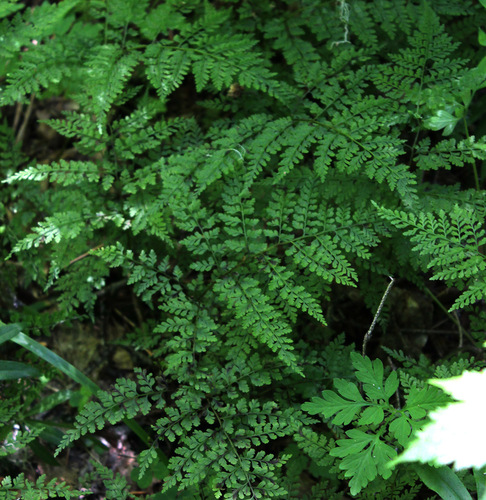
Bladderfern
ENEndangered

Bladderfern

Cystopteris sudetica

Bladderfern (Cystopteris sudetica) is a delicate perennial fern characterized by its finely divided, lace-like fronds that emerge from rocky crevices and cliff faces. This small to medium-sized fern typically reaches 10-30 cm in height and displays distinctive bladder-like indusia covering its sori on the undersides of fertile fronds.

Photo: iNaturalist: (c) Dmitriy Bochkov, some rights reserved (CC BY), uploaded by Dmitriy Bochkov

01Classification

Taxonomy & Classification

Kingdom

Plantae

Phylum

Tracheophyta

Class

Polypodiopsida

Order

Polypodiales

Family

Cystopteridaceae

Genus

Cystopteris

Bladderfern belongs to the family Cystopteridaceae, order Polypodiales, within the Polypodiopsida class.

02Description

Species Profile

Bladderfern (Cystopteris sudetica) is a delicate perennial fern characterized by its finely divided, lace-like fronds that emerge from rocky crevices and cliff faces. This small to medium-sized fern typically reaches 10-30 cm in height and displays distinctive bladder-like indusia covering its sori on the undersides of fertile fronds. As a pioneer species in rocky environments, it plays an important role in soil formation and provides microhabitat for small invertebrates in harsh montane ecosystems.

Cystopteris sudetica faces severe population declines primarily due to habitat destruction and fragmentation of its specialized montane environments. Climate change poses an additional threat by altering the cool, moist conditions this alpine fern requires, while human activities continue to degrade its limited remaining habitat.

Key Facts

IUCN StatusEndangered (EN)
GroupPlants
03Habitat

Habitat & Distribution

Bladderfern inhabits cool, moist rock crevices, cliff faces, and rocky outcrops in mountainous regions, typically at elevations between 800-2000 meters. The species shows a strong preference for calcareous substrates and north-facing slopes where it can access consistent moisture while remaining protected from direct sunlight and extreme temperature fluctuations.

04Threats

Threats

!

IUCN Red List: Endangered

Cystopteris sudetica faces severe population declines primarily due to habitat destruction and fragmentation of its specialized montane environments. Climate change poses an additional threat by altering the cool, moist conditions this alpine fern requires, while human activities continue to degrade its limited remaining habitat.

Climate change and warming temperatures

HighOngoing

Habitat loss and fragmentation

HighOngoing

Changes in hydrology

MediumOngoing

Human disturbance and trampling

MediumOngoing

Small population size and genetic isolation

MediumOngoing
07National Status

National vs Global Threat Status

How this species is assessed at the national level compared to its IUCN global status (EN).

CountryNational StatusGlobal StatusComparison
EUNTNear ThreatenedENEndangeredLower local risk

National Red List data sourced from the National Red List Project (nationalredlist.org, ZSL) and country-specific Red List authorities.

Community

Community Sightings

Report a sighting

No community sightings yet. Be the first to report!

07Sources

Sources & Attribution

How to Cite

IUCN: IUCN (2025). The IUCN Red List of Threatened Species. Version 2025-1. Available at: https://www.iucnredlist.org. doi:10.2305/IUCN.UK.2025-1.RLTS

GBIF: GBIF.org (2025). GBIF Home Page. Available at: https://www.gbif.org

National Red Lists: ZSL (2025). National Red List. Zoological Society of London. Available at: https://www.nationalredlist.org

This page: SpeciesRadar (2025). Bladderfern (Cystopteris sudetica). SpeciesRadar: Intelligence for Earth's Biodiversity. Available at: https://speciesradar.org/species/bladderfern

Full citation guide & data usage terms