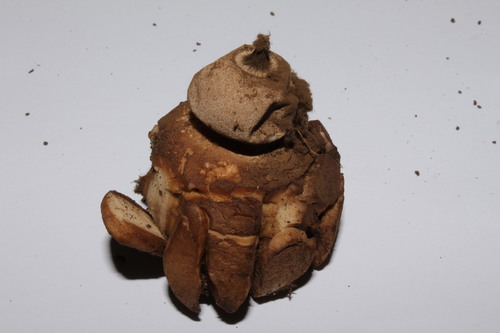
Berkeley's Earthstar
Geastrum berkeleyi
Photo: iNaturalist: (c) Σάββας Ζαφειρίου (Savvas Zafeiriou), some rights reserved (CC BY-NC), uploaded by Σάββας Ζαφειρίου (Savvas Zafeiriou)
Overview
Geastrum berkeleyi, or Berkeley's earthstar, is an inedible species of mushroom belonging to the genus Geastrum, or earthstar fungi. It can be distinguished from other Geastrum species by the flat bipyramidal shape of the calcium oxalate crystals found on its endoperidium.
Berkeley's Earthstar faces severe population declines primarily due to habitat loss from urban development and agricultural conversion of its specialized woodland habitats. The species is particularly vulnerable because of its limited distribution, specific ecological requirements, and sensitivity to environmental disturbances that affect its mycorrhizal relationships with host trees.
Habitat
European countries it is found in include Austria, the Czech Republic, Denmark, Estonia, Finland, Great Britain, Hungary, the Netherlands, Poland,
}}
Other threatened species in Geastraceae


Frequently asked questions
Why is Berkeley's Earthstar classified as Endangered?
Where does Berkeley's Earthstar live?
What are the main threats to Berkeley's Earthstar?
Get weekly conservation intelligence
One short digest a week of the most striking species and country data we ship, plus breaking conservation news paired with our database where it matters.
Free, no spam. One-click unsubscribe in every email.