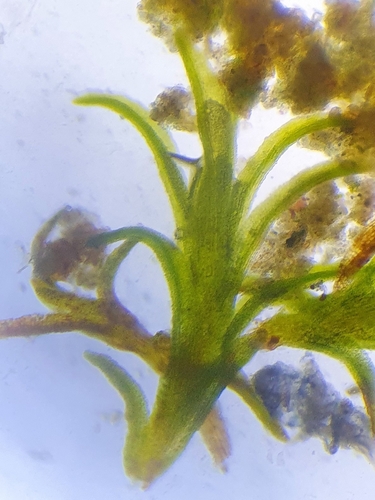
Beric Beard-moss
VUVulnerable

Beric Beard-moss

Leptobarbula berica

Beric Beard-moss (Leptobarbula berica) is a small acrocarpous moss species characterized by its distinctive beard-like peristome teeth and narrow, lance-shaped leaves that form compact cushions. This bryophyte plays a crucial ecological role in soil stabilization and moisture retention in its specialized habitats, while providing microhabitat for invertebrates and contributing to nutrient cycling in fragile ecosystems.

Photo: iNaturalist: никакие права не защищены, загрузил Jonathan Hughes

01Classification

Taxonomy & Classification

Kingdom

Plantae

Phylum

Bryophyta

Class

Bryopsida

Order

Pottiales

Family

Pottiaceae

Genus

Leptobarbula

Beric Beard-moss belongs to the family Pottiaceae, order Pottiales, within the Bryopsida class.

02Description

Species Profile

Beric Beard-moss (Leptobarbula berica) is a small acrocarpous moss species characterized by its distinctive beard-like peristome teeth and narrow, lance-shaped leaves that form compact cushions. This bryophyte plays a crucial ecological role in soil stabilization and moisture retention in its specialized habitats, while providing microhabitat for invertebrates and contributing to nutrient cycling in fragile ecosystems.

Beric Beard-moss faces significant threats from habitat degradation and loss due to urbanization and agricultural expansion in its limited range. Climate change poses additional risks through altered precipitation patterns and temperature increases that affect the specific moisture conditions this moss requires. The species' restricted distribution makes it particularly vulnerable to local environmental changes.

Key Facts

IUCN StatusVulnerable (VU)
GroupPlants
03Habitat

Habitat & Distribution

This moss species typically grows on calcareous rocks, walls, and soil in Mediterranean scrubland and dry grassland environments. It favors semi-arid habitats with specific moisture and pH conditions, often found on limestone substrates in areas with seasonal rainfall patterns.

04Threats

Threats

Agricultural expansion and land conversion

HighOngoing

Habitat loss from urban development

HighOngoing

Air pollution and atmospheric deposition

MediumOngoing

Climate change affecting moisture regimes

MediumOngoing

Trampling and recreational disturbance

LowOngoing
07National Status

National vs Global Threat Status

How this species is assessed at the national level compared to its IUCN global status (VU).

CountryNational StatusGlobal StatusComparison
EULCLeast ConcernVUVulnerableLower local risk

National Red List data sourced from the National Red List Project (nationalredlist.org, ZSL) and country-specific Red List authorities.

Community

Community Sightings

Report a sighting

No community sightings yet. Be the first to report!

07Sources

Sources & Attribution

How to Cite

IUCN: IUCN (2025). The IUCN Red List of Threatened Species. Version 2025-1. Available at: https://www.iucnredlist.org. doi:10.2305/IUCN.UK.2025-1.RLTS

GBIF: GBIF.org (2025). GBIF Home Page. Available at: https://www.gbif.org

National Red Lists: ZSL (2025). National Red List. Zoological Society of London. Available at: https://www.nationalredlist.org

This page: SpeciesRadar (2025). Beric Beard-moss (Leptobarbula berica). SpeciesRadar: Intelligence for Earth's Biodiversity. Available at: https://speciesradar.org/species/beric-beard-moss

Full citation guide & data usage terms