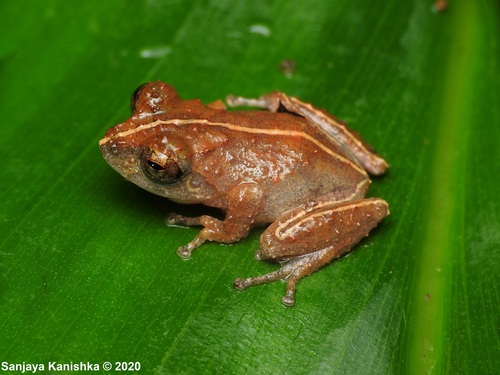
Pseudophilautus bambaradeniyai
Local name: Bambaradeniya’s Shrub Frog
Photo: Photo: (c) Sanjaya Kanishka, some rights reserved (CC BY-NC), uploaded by Sanjaya Kanishka
Overview
Bambaradeniya's Shrub Frog is a small arboreal amphibian endemic to Sri Lanka's montane forests. This diminutive species exhibits the characteristic features of the *Pseudophilautus* genus, with adhesive toe pads adapted for climbing vegetation and a cryptic coloration that provides camouflage among forest foliage. Like other shrub frogs, it likely plays an important role in forest ecosystems as both predator of small invertebrates and prey for larger animals.
The species is restricted to high-elevation wet zone forests in Sri Lanka's central highlands. These montane environments are characterized by cool temperatures, high humidity, and dense canopy cover—conditions essential for the survival of moisture-dependent amphibians. The frog's arboreal lifestyle makes it particularly dependent on intact forest structure and vegetation.
As a Critically Endangered species, Bambaradeniya's Shrub Frog faces severe threats to its survival, though specific threat assessments remain incomplete. Sri Lankan amphibians generally face pressure from habitat loss due to agricultural expansion, urban development, and tea plantation establishment in highland areas. Climate change poses additional risks through altered precipitation patterns and temperature increases that could affect the cool, moist conditions these frogs require.
Current conservation efforts for this species are limited, reflecting the broader challenges facing Sri Lanka's endemic amphibian fauna. The species' conservation status highlights the urgent need for comprehensive surveys to determine population size, distribution, and specific threats. Without immediate research and protection measures, this endemic frog faces an uncertain future in Sri Lanka's rapidly changing landscape.
The specific threats to Bambaradeniya's Shrub Frog have not yet been formally assessed by researchers. Without this threat assessment, scientists cannot determine what dangers this species faces or how severe they might be. It is therefore unknown whether threats to this frog are increasing, stable, or decreasing over time.
Habitat
Conservation measures underway
Other threatened species in RHACOPHORIDAE
Threatened in Sri Lanka

Frequently asked questions
Why is Bambaradeniya’s Shrub Frog classified as Critically Endangered?
Where does Bambaradeniya’s Shrub Frog live?
What are the main threats to Bambaradeniya’s Shrub Frog?
Get weekly conservation intelligence
One short digest a week of the most striking species and country data we ship, plus breaking conservation news paired with our database where it matters.
Free, no spam. One-click unsubscribe in every email.