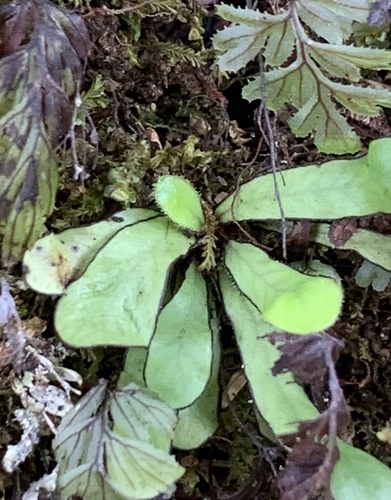
Azorean Finger Fern
Grammitis azorica
Photo: Photo: (c) Hanno Schaefer, all rights reserved, uploaded by Hanno Schaefer
Overview
Grammitis azorica is a critically endangered fern endemic to the Azores archipelago in the North Atlantic Ocean. This delicate epiphytic species belongs to the Polypodiaceae family and represents one of the most threatened plant species in Macaronesia. The fern displays characteristic small, leathery fronds that grow in dense clusters on moss-covered tree trunks and branches within the archipelago's native laurel forests.
Its fronds typically measure 3-8 centimeters in length with a distinctive linear-lanceolate shape and entire margins. The species exhibits the typical sporangial patterns of its genus, with sori arranged along the frond undersides. Grammitis azorica inhabits the remnant native forests of the Azores, particularly in areas with high humidity and consistent moisture levels between 400-800 meters elevation.
The species requires the specific microclimate conditions found in well-preserved laurel forest fragments, where it grows as an epiphyte on endemic tree species. Its distribution is extremely restricted, known from only a few locations across select islands in the archipelago. The IUCN Red List classifies this species as Critically Endangered due to its severely fragmented population and continuing decline.
The species faces immediate extinction risk from habitat degradation and the invasion of non-native plant species that alter forest structure and microclimate conditions. However, recent botanical surveys have successfully relocated several populations previously thought extinct, and targeted habitat restoration efforts in protected areas of the Azores Natural Park are showing promising results for native forest recovery, offering hope for this remarkable endemic fern's survival.
Grammitis azorica faces severe threats from the invasion of aggressive non-native plant species, particularly Australian cheesewood and ginger lily, which fundamentally alter the forest canopy structure and reduce the humid microclimate conditions essential for this epiphytic fern's survival. Habitat fragmentation from historical deforestation and ongoing agricultural expansion has isolated remaining populations into tiny forest patches, making them extremely vulnerable to local extinctions. Climate change poses an additional threat by potentially shifting the optimal elevation zones and moisture regimes that this moisture-dependent species requires for reproduction and growth.
Habitat
This species inhabits the humid native laurel forests of the Azores, growing exclusively as an epiphyte on moss-covered trunks and branches of endemic trees at elevations between 400-800 meters. It requires the consistently moist, shaded microclimate found in well-preserved forest fragments with dense canopy cover and high atmospheric humidity.
Conservation measures underway
Other threatened species in POLYPODIACEAE
Threatened in Portugal
Frequently asked questions
Why is Azorean Finger Fern classified as Critically Endangered?
Where does Azorean Finger Fern live?
What are the main threats to Azorean Finger Fern?
Get weekly conservation intelligence
One short digest a week of the most striking species and country data we ship, plus breaking conservation news paired with our database where it matters.
Free, no spam. One-click unsubscribe in every email.