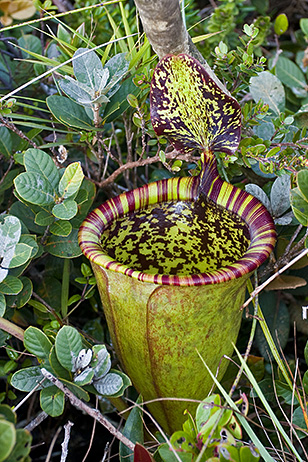
Attenborough's Pitcher Plant
Nepenthes attenboroughii
Photo: Photo: Wikimedia Commons, CC BY-SA
Overview
Attenborough's Pitcher Plant (Nepenthes attenboroughii)
Attenborough's pitcher plant is one of the world's largest carnivorous plants, with pitchers reaching up to 30 centimeters in length. These modified leaves form deep, slippery-walled traps that capture insects, small vertebrates, and occasionally rodents. The plant digests prey using enzymes and bacteria within the pitcher fluid, supplementing nutrients in its nutrient-poor environment. As an apex carnivorous plant, it plays a unique role in its ecosystem's food web.
This species is endemic to Mount Victoria in Palawan, Philippines, discovered only in 2007. It grows exclusively on ultramafic soils at elevations between 1,450-1,726 meters, thriving in the mountain's summit vegetation where few other plants can survive the harsh conditions.
The plant faces severe threats from its extremely limited range, existing on less than 10 square kilometers of mountaintop habitat. Illegal collection for the international carnivorous plant trade poses a significant risk, with individual plants commanding high prices among collectors. Climate change threatens to shift suitable habitat zones upward, potentially eliminating available growing space on the mountain summit.
Mining activities and agricultural expansion in the broader region could impact watershed dynamics affecting the summit ecosystem.
Conservation efforts include protection within Mount Victoria's proposed protected area status and monitoring by local researchers. International trade restrictions under CITES provide some protection against commercial exploitation.
The species' outlook remains precarious due to its minute population size and restricted range. Without enhanced protection measures and habitat preservation, this remarkable plant faces potential extinction within decades.
Based on the available data, the specific threats to Attenborough's Pitcher Plant have not yet been formally assessed by conservation scientists. Without this threat assessment, it's not possible to identify what particular dangers this species faces or describe how human activities might be affecting its survival. The status of whether threats are increasing, stable, or decreasing cannot be determined until a proper threat evaluation is completed.
Habitat
Conservation measures underway
Other threatened species in NEPENTHACEAE
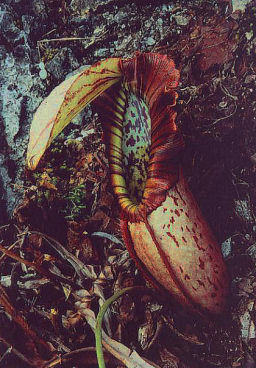

Threatened in Philippines

Frequently asked questions
Why is Attenborough's Pitcher Plant classified as Critically Endangered?
Where does Attenborough's Pitcher Plant live?
What are the main threats to Attenborough's Pitcher Plant?
Get weekly conservation intelligence
One short digest a week of the most striking species and country data we ship, plus breaking conservation news paired with our database where it matters.
Free, no spam. One-click unsubscribe in every email.