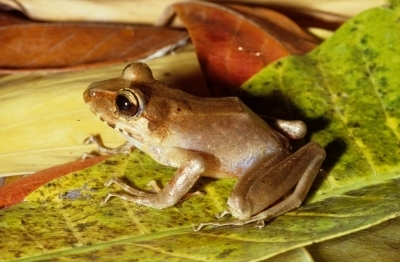
Craugastor andi
# Atlantic Robber Frog (Craugastor andi) The Atlantic Robber Frog is a small terrestrial amphibian endemic to the cloud forests of Honduras. This diminutive species measures approximately 15-20mm in length, with a brown to grayish coloration that provides effective camouflage among leaf litter.
↓Decreasing
Population trend
2
Countries
Photo: (c) STRI, some rights reserved (CC BY-NC)
Taxonomy & Classification
Kingdom
ANIMALIA
Phylum
CHORDATA
Class
AMPHIBIA
Order
ANURA
Family
CRAUGASTORIDAE
Genus
Craugastor
Craugastor andi belongs to the family CRAUGASTORIDAE, order ANURA, within the AMPHIBIA class.
Species Profile
# Atlantic Robber Frog (Craugastor andi) The Atlantic Robber Frog is a small terrestrial amphibian endemic to the cloud forests of Honduras. This diminutive species measures approximately 15-20mm in length, with a brown to grayish coloration that provides effective camouflage among leaf litter. Like other members of the Craugastor genus, it undergoes direct development, with eggs hatching directly into miniature frogs rather than tadpoles, eliminating dependence on aquatic breeding sites. **Geographic Range and Habitat** This species is known only from the Cordillera Nombre de Dios in northern Honduras, specifically from elevations between 1,200-1,800 meters. It inhabits pristine cloud forest environments characterized by persistent moisture, dense canopy cover, and rich organic soil layers where it forages among decomposing vegetation. **Threats** The primary threat to C. andi is habitat destruction through deforestation and agricultural conversion of cloud forest areas. Climate change poses an additional significant risk, as rising temperatures and altered precipitation patterns threaten the specific microclimatic conditions these frogs require. The species' extremely limited range makes it particularly vulnerable to localized environmental changes. **Conservation Status** Currently, no specific conservation programs target this species directly. Protection efforts focus on broader cloud forest preservation initiatives in the region. The species' remote habitat provides some natural protection, though enforcement of existing protected area regulations remains challenging. **Outlook** The Atlantic Robber Frog's future remains highly uncertain. Its critically endangered status reflects both its restricted range and ongoing habitat pressures. Without targeted conservation intervention and effective habitat protection, this endemic species faces significant extinction risk.
The primary threats to the Atlantic Robber Frog have not been formally assessed or documented by researchers. Without a proper threat evaluation, it's unclear what specific dangers this species faces in its natural habitat. The status of threats to this frog - whether they are getting worse, staying the same, or improving - cannot be determined without further scientific study.
Key Facts
Habitat & Distribution
Threats
IUCN Red List: Critically Endangered
The primary threats to the Atlantic Robber Frog have not been formally assessed or documented by researchers. Without a proper threat evaluation, it's unclear what specific dangers this species faces in its natural habitat. The status of threats to this frog - whether they are getting worse, staying the same, or improving - cannot be determined without further scientific study.
Habitat shifting & alteration
Invasive non-native/alien species/diseases
Conservation Actions
Found in 2 Countries
Community Sightings
Report a sightingNo community sightings yet. Be the first to report!
Sources & Attribution
How to Cite
IUCN: IUCN (2025). The IUCN Red List of Threatened Species. Version 2025-1. Available at: https://www.iucnredlist.org. doi:10.2305/IUCN.UK.2025-1.RLTS
GBIF: GBIF.org (2025). GBIF Home Page. Available at: https://www.gbif.org
This page: SpeciesRadar (2025). Craugastor andi (Craugastor andi). SpeciesRadar: Intelligence for Earth's Biodiversity. Available at: https://speciesradar.org/species/atlantic-robber-frog