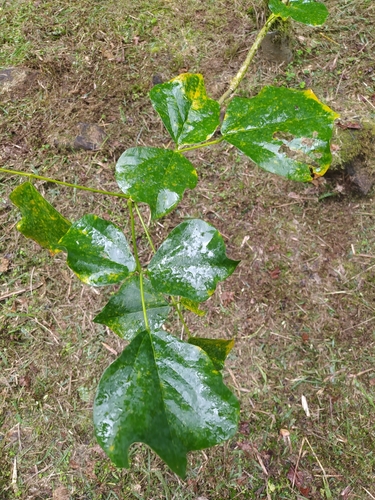
Erythrina tahitensis
Photo: Photo: (c) solenefabreb, some rights reserved (CC BY-NC)
Overview
Erythrina tahitensis is a critically endangered coral tree endemic to French Polynesia, representing one of the Pacific's most imperiled native flowering trees. This distinctive leguminous species belongs to the Fabaceae family and displays the characteristic features of coral trees, with compound leaves, vibrant red-orange flowers arranged in terminal racemes, and a broad, spreading canopy when mature. The tree typically reaches heights of 8-15 meters and produces the iconic curved seed pods common to Erythrina species.
Historically distributed across several islands in the Society Islands archipelago, E. tahitensis now persists in extremely fragmented populations primarily on Tahiti and possibly Moorea, where it inhabits coastal lowland forests, valley bottoms, and forest edges at elevations below 300 meters. The species prefers well-drained volcanic soils and areas with partial shade to full sunlight.
Its striking flowers, which bloom seasonally, serve as important nectar sources for native pollinators and historically played roles in traditional Polynesian culture. The IUCN Red List classifies Erythrina tahitensis as Critically Endangered, reflecting severe population declines and habitat fragmentation over recent decades. Current population estimates suggest fewer than 50 mature individuals remain in the wild, distributed across highly fragmented sites.
The species faces an extremely high risk of extinction without immediate conservation intervention. Encouragingly, botanical gardens in French Polynesia and internationally have begun maintaining ex-situ collections, and recent surveys have identified previously unknown individuals, providing hope for targeted conservation efforts. Local conservation organizations are now working with territorial authorities to establish protection measures for remaining habitat patches and develop propagation protocols for potential reintroduction programs.
Erythrina tahitensis faces severe threats from invasive plant species that aggressively compete for space and resources in its native lowland forest habitat, particularly fast-growing exotic trees and shrubs that alter forest structure and light availability. Urban development and agricultural expansion across Tahiti's limited coastal lowlands have eliminated much of the species' historical range, fragmenting remaining populations into isolated patches too small to maintain viable breeding populations. Additionally, the introduction of the Erythrina gall wasp (Quadrastichus erythrinae) has severely impacted coral trees throughout the Pacific, causing defoliation and weakening trees' reproductive capacity.
Habitat
Erythrina tahitensis inhabits coastal lowland forests and forest margins on volcanic islands in French Polynesia, typically occurring at elevations below 300 meters in areas with well-drained volcanic soils. The species favors partially shaded to sunny locations along valley bottoms, forest edges, and disturbed forest areas where it can establish in gaps within the native forest canopy.
Other threatened species in FABACEAE
Frequently asked questions
Why is Erythrina tahitensis classified as Critically Endangered?
Where does Erythrina tahitensis live?
What are the main threats to Erythrina tahitensis?
Get weekly conservation intelligence
One short digest a week of the most striking species and country data we ship, plus breaking conservation news paired with our database where it matters.
Free, no spam. One-click unsubscribe in every email.