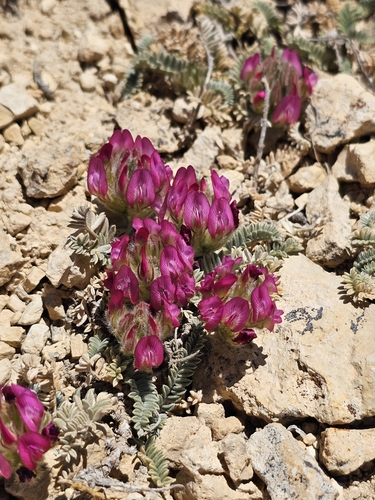
Astragalus kurnet-es-saudae
Photo: Photo: (c) Akkar Trail, some rights reserved (CC BY-NC), uploaded by Akkar Trail
Overview
Astragalus kurnet-es-saudae is a critically endangered legume endemic to the Arabian Peninsula, representing one of the region's most imperiled plant species. This perennial herb belongs to the diverse milkvetch genus and exhibits the characteristic compound leaves and papilionaceous flowers typical of the Fabaceae family. The species produces small, clustered purple or pink flowers that bloom during the brief spring season, followed by distinctive inflated seed pods that aid in wind dispersal across the arid landscape.
Found exclusively in rocky limestone outcrops and gravelly wadis of Saudi Arabia, this rare plant has adapted to extreme desert conditions through deep taproot systems and drought-deciduous foliage that minimizes water loss during the harshest months. The species occupies a highly restricted range within specific geological formations, making it particularly vulnerable to habitat disturbance. Its Critically Endangered status reflects both its extremely limited distribution and ongoing population decline driven by infrastructure development, quarrying activities, and overgrazing by livestock.
Climate change poses additional threats through altered precipitation patterns and increased temperature extremes that may exceed the species' physiological tolerance. Despite these challenges, recent botanical surveys have confirmed the persistence of several small populations, and the species' inclusion in regional conservation assessments has raised awareness among local authorities. Seed banking efforts by regional botanical institutions offer hope for ex-situ conservation, while proposed habitat protection measures could safeguard remaining wild populations of this remarkable desert endemic.
Astragalus kurnet-es-saudae faces severe threats from limestone quarrying operations that directly destroy its specialized rocky habitat, with several known populations already eliminated by mining activities. Intensive livestock grazing, particularly by goats and camels, prevents successful reproduction by consuming flowers and seedlings before they can establish. Urban expansion and road construction across its limited range continue to fragment the remaining populations, while altered hydrology from development disrupts the natural water flow patterns in wadis that the species depends upon for survival.
Habitat
This species inhabits limestone cliffs, rocky outcrops, and gravelly seasonal watercourses (wadis) in arid regions of Saudi Arabia, typically at elevations between 400-800 meters. It requires well-drained, alkaline soils with specific mineral compositions found only in particular geological formations of the Arabian Peninsula.
Conservation measures underway
Other threatened species in FABACEAE
Threatened in Lebanon

Frequently asked questions
Why is Astragalus kurnet-es-saudae classified as Critically Endangered?
Where does Astragalus kurnet-es-saudae live?
What are the main threats to Astragalus kurnet-es-saudae?
Get weekly conservation intelligence
One short digest a week of the most striking species and country data we ship, plus breaking conservation news paired with our database where it matters.
Free, no spam. One-click unsubscribe in every email.