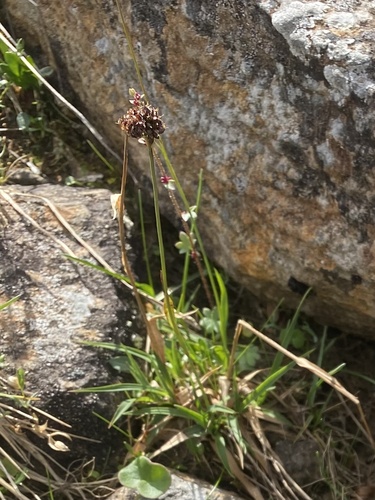
arctic woodrush
Luzula nivalis
Luzula nivalis, commonly known as arctic wood-rush or less commonly as snowy wood-rush, is a species of perennial rush native to the North American Arctic and Northern Europe. It was described by Polunin (1940) as one of the most abundant, ubiquitous, and ecologically important of all arctic plants.
Photo: iNaturalist: (c) Илья Руденко, some rights reserved (CC BY), uploaded by Илья Руденко
Taxonomy & Classification
Kingdom
Plantae
Phylum
Tracheophyta
Class
Liliopsida
Order
Poales
Family
Juncaceae
Genus
Luzula
arctic woodrush belongs to the family Juncaceae, order Poales, within the Liliopsida class.
Species Profile
Luzula nivalis, commonly known as arctic wood-rush or less commonly as snowy wood-rush, is a species of perennial rush native to the North American Arctic and Northern Europe. It was described by Polunin (1940) as one of the most abundant, ubiquitous, and ecologically important of all arctic plants.
Arctic woodrush faces severe threats from climate change, as rising temperatures and altered precipitation patterns degrade its specialized high-altitude and arctic habitats. The species' extremely limited distribution and small population sizes make it particularly vulnerable to habitat loss and fragmentation from human activities and environmental changes.
Key Facts
Habitat & Distribution
Luzula nivalis has an arctic-alpine circumpolar distribution, as L. nivalis is an alpine plant which grows in the arctic regions of the northern hemisphere. Luzula nivalis has been found in a wide range of mainly moist habitats and substrates, including wet meadows, snow patches, seepages, along the margins of ponds, marshes, streams (and other water bodies) as well as tundra, slopes and ridges....
Threats
IUCN Red List: Endangered
Arctic woodrush faces severe threats from climate change, as rising temperatures and altered precipitation patterns degrade its specialized high-altitude and arctic habitats. The species' extremely limited distribution and small population sizes make it particularly vulnerable to habitat loss and fragmentation from human activities and environmental changes.
Climate change and warming temperatures
Habitat loss and degradation
Limited distribution and small population size
Altered precipitation patterns
Human disturbance in alpine areas
National vs Global Threat Status
How this species is assessed at the national level compared to its IUCN global status (EN).
| Country | National Status | Global Status | Comparison |
|---|---|---|---|
| EU | LCLeast Concern | ENEndangered | Lower local risk |
| EU | LCLeast Concern | ENEndangered | Lower local risk |
National Red List data sourced from the National Red List Project (nationalredlist.org, ZSL) and country-specific Red List authorities.
Community Sightings
Report a sightingNo community sightings yet. Be the first to report!
Sources & Attribution
How to Cite
IUCN: IUCN (2025). The IUCN Red List of Threatened Species. Version 2025-1. Available at: https://www.iucnredlist.org. doi:10.2305/IUCN.UK.2025-1.RLTS
GBIF: GBIF.org (2025). GBIF Home Page. Available at: https://www.gbif.org
National Red Lists: ZSL (2025). National Red List. Zoological Society of London. Available at: https://www.nationalredlist.org
This page: SpeciesRadar (2025). arctic woodrush (Luzula nivalis). SpeciesRadar: Intelligence for Earth's Biodiversity. Available at: https://speciesradar.org/species/arctic-woodrush