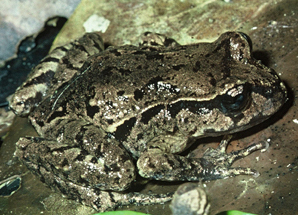
Leiopelma archeyi
CRCritically Endangered

Leiopelma archeyi

**Archey's Frog (Leiopelma archeyi)** Archey's frog is one of New Zealand's four endemic primitive frogs, representing an ancient lineage that has remained largely unchanged for millions of years. This small amphibian measures 31-37mm in length and displays brown, green, or reddish coloration with distinctive toe discs for climbing.

Stable

Population trend

1

Countries

Photo: Wikimedia Commons (CC) via https://en.wikipedia.org/wiki/Archey's_frog

01Classification

Taxonomy & Classification

Kingdom

ANIMALIA

Phylum

CHORDATA

Class

AMPHIBIA

Order

ANURA

Family

LEIOPELMATIDAE

Genus

Leiopelma

Leiopelma archeyi belongs to the family LEIOPELMATIDAE, order ANURA, within the AMPHIBIA class.

02Description

Species Profile

**Archey's Frog (Leiopelma archeyi)** Archey's frog is one of New Zealand's four endemic primitive frogs, representing an ancient lineage that has remained largely unchanged for millions of years. This small amphibian measures 31-37mm in length and displays brown, green, or reddish coloration with distinctive toe discs for climbing. Unlike most frogs, Archey's frog lacks a tadpole stage, with young developing directly from eggs into miniature frogs. Males carry developing young on their backs, and the species exhibits minimal vocalization compared to other frogs. These frogs play important roles as both predators of small invertebrates and prey for native birds and reptiles. Originally distributed across New Zealand's North Island, Archey's frog now survives in only a few isolated populations in the Coromandel Peninsula and Whareorino Forest. The species inhabits native forest environments, particularly areas with dense vegetation, fallen logs, and rock crevices that provide essential moisture and shelter. The species faces severe threats from chytrid fungus (Batrachochytrium dendrobatidis), which has caused dramatic population declines since the 1990s. Habitat fragmentation, introduced predators including rats and possums, and climate change compound these pressures. The frog's limited dispersal ability makes recolonization of affected areas extremely difficult. Conservation efforts include captive breeding programs, predator control in remaining habitat areas, and translocation attempts to establish new populations in predator-free environments. Researchers continue monitoring existing populations and studying disease resistance. The outlook remains precarious, with continued population fragmentation and ongoing disease pressure. Without sustained intensive management, this ancient species faces potential extinction within decades.

Based on the threat data provided, the specific threats facing Archey's Frog have not been formally assessed or documented in detail. Without a proper threat assessment, it's not possible to identify the particular dangers this species faces or describe how human activities or environmental changes might be affecting its survival. The current status of whether threats are increasing, stable, or decreasing cannot be determined without this essential threat information.

Key Facts

IUCN StatusCritically Endangered (CR)
TrendStable
GroupAmphibians
03Habitat

Habitat & Distribution

ForestMajor
04Threats

Threats

!

IUCN Red List: Critically Endangered

Based on the threat data provided, the specific threats facing Archey's Frog have not been formally assessed or documented in detail. Without a proper threat assessment, it's not possible to identify the particular dangers this species faces or describe how human activities or environmental changes might be affecting its survival. The current status of whether threats are increasing, stable, or decreasing cannot be determined without this essential threat information.

Invasive non-native/alien species/diseases

Ongoing

Logging & wood harvesting

Ongoing

Mining & quarrying

Ongoing
05Conservation

Conservation Actions

Invasive/problematic species control
Species management
Species recovery
Ex-situ conservation
Awareness & communications
06Range

Found in 1 Country

Community

Community Sightings

Report a sighting

No community sightings yet. Be the first to report!

07Sources

Sources & Attribution

How to Cite

IUCN: IUCN (2025). The IUCN Red List of Threatened Species. Version 2025-1. Available at: https://www.iucnredlist.org. doi:10.2305/IUCN.UK.2025-1.RLTS

GBIF: GBIF.org (2025). GBIF Home Page. Available at: https://www.gbif.org

This page: SpeciesRadar (2026). Leiopelma archeyi (Leiopelma archeyi). SpeciesRadar: Intelligence for Earth's Biodiversity. Available at: https://speciesradar.org/species/archeys-frog

Full citation guide & data usage terms