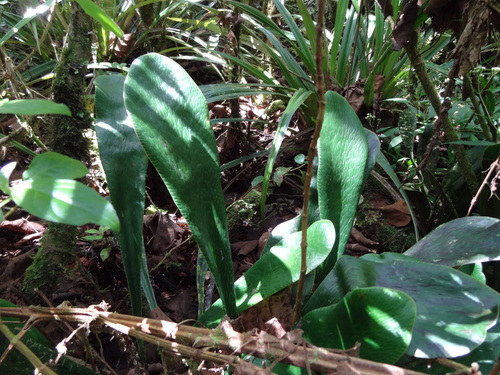
Antrophyopsis boryana
Photo: iNaturalist: (c) Jean-Philippe BASUYAUX, some rights reserved (CC BY-NC), uploaded by Jean-Philippe BASUYAUX
Overview
Antrophyopsis boryana, commonly known as Antrophyon de Bory, Langue de boeuf, or Langue de vache, is a critically endangered fern species endemic to the Mascarene Islands in the Indian Ocean. This distinctive pteridaceous fern displays large, leathery fronds with a characteristic tongue-like appearance that inspired its French common names meaning 'ox tongue' and 'cow tongue.' The species produces robust, evergreen fronds that can reach considerable size, with a thick, succulent texture adapted to its specialized habitat requirements. Antrophyopsis boryana inhabits the remaining fragments of native montane forest ecosystems, typically growing as an epiphyte on tree trunks and branches in humid, shaded conditions at elevations between 400-800 meters.
The species was historically distributed across Mauritius and Réunion, but its range has contracted dramatically due to extensive deforestation and habitat conversion. Currently classified as Critically Endangered by the IUCN, this ancient fern lineage represents one of the most threatened pteridophytes in the Mascarene archipelago. The species exhibits slow growth rates and specific microhabitat requirements that make it particularly vulnerable to environmental changes.
However, recent botanical surveys have rediscovered small populations in protected forest reserves, and specialized propagation techniques developed by regional botanical gardens offer hope for ex-situ conservation efforts. Conservation biologists are working with local authorities to establish habitat corridors connecting remaining forest fragments, which could benefit this species alongside other endemic Mascarene flora. The discovery of previously unknown populations in remote ravines demonstrates the importance of continued field surveys in these biodiverse island ecosystems.
The primary threat to Antrophyopsis boryana stems from the extensive clearance of native montane forests across the Mascarene Islands for agricultural development and urban expansion, which has eliminated an estimated 95% of suitable epiphytic habitat. Invasive plant species, particularly aggressive climbing vines and fast-growing exotic trees, alter forest structure and microclimate conditions essential for this fern's survival. Climate change poses an additional threat through altered precipitation patterns and increased cyclone intensity, which can destroy the mature forest canopy that provides the humid, stable conditions this species requires.
Habitat
Antrophyopsis boryana occupies humid montane forest environments in the Mascarene Islands, growing primarily as an epiphyte on the trunks and major branches of native trees within the forest canopy. The species requires consistently moist conditions with filtered sunlight and stable temperatures, typically found in well-preserved forest fragments between 400-800 meters elevation.
Other threatened species in Pteridaceae

Frequently asked questions
Why is Antrophyopsis boryana classified as Critically Endangered?
Where does Antrophyopsis boryana live?
What are the main threats to Antrophyopsis boryana?
Get weekly conservation intelligence
One short digest a week of the most striking species and country data we ship, plus breaking conservation news paired with our database where it matters.
Free, no spam. One-click unsubscribe in every email.