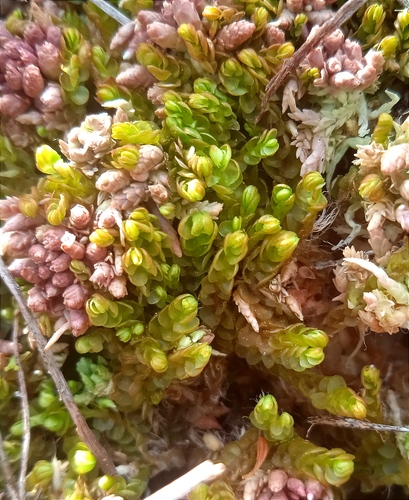
Anomalous Flapwort
Mylia anomala
Photo: iNaturalist: (c) GOTH, some rights reserved (CC BY-NC), uploaded by GOTH
Overview
Mylia anomala, commonly known as the Anomalous Flapwort, is a critically endangered (CR) liverwort species belonging to the family Myliaceae. This diminutive bryophyte displays the characteristic flattened, leaf-like structures typical of leafy liverworts, with distinctive lobed segments that give rise to its common name. The plant forms small, creeping mats with overlapping scale-like leaves arranged in two rows, typically measuring only a few centimeters across.
Its reproductive structures, when present, appear as small, umbrella-like formations called archegoniophores. The Anomalous Flapwort inhabits highly specialized microhabitats within temperate and boreal forest ecosystems, particularly favoring the surfaces of decaying logs, tree bases, and acidic soil in old-growth coniferous forests. Its distribution appears to be extremely limited, with confirmed populations restricted to scattered locations across northern Europe and possibly parts of North America, though precise range data remains incomplete due to the species' cryptic nature and identification challenges.
The species demonstrates a strong preference for stable, humid microclimates with consistent moisture levels and minimal disturbance. Like many bryophytes, M. anomala plays important ecological roles in forest ecosystems, contributing to nutrient cycling and providing microhabitat for invertebrates.
Recent targeted surveys by bryophyte specialists have successfully relocated several historical populations previously thought extinct, offering hope for the species' persistence. Conservation efforts now focus on protecting known habitat sites and conducting systematic surveys in suitable forest remnants to better understand the species' true distribution and population status.
The primary threat to Mylia anomala stems from the widespread loss and fragmentation of old-growth forest habitats, particularly through commercial logging operations that remove the large, decaying logs essential for the species' survival. Climate change poses an additional significant risk, as altered precipitation patterns and increased temperature fluctuations disrupt the stable, humid microclimates that this moisture-dependent liverwort requires. Forest management practices that remove deadwood and promote rapid forest turnover further eliminate the specialized substrates and long-term habitat stability necessary for population persistence.
Habitat
Mylia anomala occupies highly specific microhabitats within mature coniferous forests, growing primarily on the surfaces of well-decayed logs, tree stumps, and occasionally on acidic humus-rich soil. The species requires consistently moist conditions with high humidity levels and protection from direct sunlight, typically found in the understory of old-growth forests with dense canopy cover.
Frequently asked questions
Why is Anomalous Flapwort classified as Critically Endangered?
Where does Anomalous Flapwort live?
What are the main threats to Anomalous Flapwort?
Get weekly conservation intelligence
One short digest a week of the most striking species and country data we ship, plus breaking conservation news paired with our database where it matters.
Free, no spam. One-click unsubscribe in every email.