Amazon Giant Glass Frog
CRCritically Endangered

Amazon Giant Glass Frog

Centrolene pipilatum

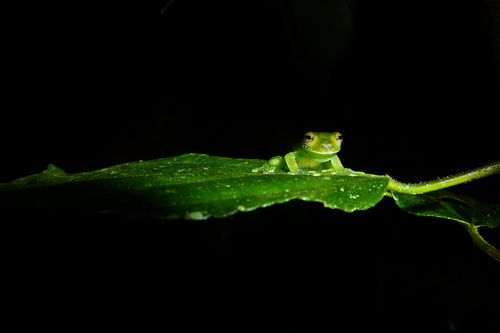
# Amazon Giant Glass Frog (Centrolene pipilatum) The Amazon Giant Glass Frog is one of the largest members of the glass frog family, distinguished by its translucent ventral skin that reveals internal organs and bone structure. Adults typically measure 6-7 centimeters in length, with bright green dorsal coloration and distinctive yellow spots along their sides.

Photo: iNaturalist: (c) Kestrel DeMarco, all rights reserved, uploaded by Kestrel DeMarco

01Classification

Taxonomy & Classification

Kingdom

Animalia

Phylum

Chordata

Class

Amphibia

Order

Anura

Family

Centrolenidae

Genus

Centrolene

Amazon Giant Glass Frog belongs to the family Centrolenidae, order Anura, within the Amphibia class.

02Description

Species Profile

# Amazon Giant Glass Frog (Centrolene pipilatum) The Amazon Giant Glass Frog is one of the largest members of the glass frog family, distinguished by its translucent ventral skin that reveals internal organs and bone structure. Adults typically measure 6-7 centimeters in length, with bright green dorsal coloration and distinctive yellow spots along their sides. These nocturnal amphibians are arboreal, spending most of their time in forest canopy vegetation near streams where males establish territories and produce distinctive calls during breeding season. This species is endemic to the cloud forests of Ecuador's eastern Andean slopes, occurring at elevations between 1,400-2,100 meters. They inhabit primary montane rainforests characterized by high humidity, consistent temperatures, and abundant epiphytic vegetation along fast-flowing streams essential for their reproductive cycle. The species faces critical threats from habitat destruction due to expanding agricultural frontiers, particularly cattle ranching and crop cultivation in Ecuador's montane regions. Mining activities and infrastructure development further fragment their limited range. Climate change poses additional risks by altering the precise temperature and humidity conditions these frogs require. Their restricted geographic range makes them particularly vulnerable to localized environmental changes. Conservation efforts remain limited due to the species' recent scientific recognition and remote habitat locations. Some populations occur within Ecuador's protected area system, though enforcement and monitoring remain challenging in these mountainous regions. The current outlook for Centrolene pipilatum remains uncertain. With an unknown population trend and continued habitat pressures, the species' critical conservation status reflects the urgent need for targeted research and protection measures to prevent potential extinction.

The primary threats to the Amazon Giant Glass Frog have not been formally assessed or documented by conservation scientists. Without this threat assessment data, it's unclear what specific dangers this species faces, though many rainforest amphibians typically encounter challenges from forest clearing, pollution, disease, and climate changes. The trend of these threats cannot be determined without proper scientific evaluation.

Key Facts

IUCN StatusCritically Endangered (CR)
GroupAmphibians
04Threats

Threats

!

IUCN Red List: Critically Endangered

The primary threats to the Amazon Giant Glass Frog have not been formally assessed or documented by conservation scientists. Without this threat assessment data, it's unclear what specific dangers this species faces, though many rainforest amphibians typically encounter challenges from forest clearing, pollution, disease, and climate changes. The trend of these threats cannot be determined without proper scientific evaluation.

Detailed threat classification data is sourced from IUCN assessments as they become available.

Community

Community Sightings

Report a sighting

No community sightings yet. Be the first to report!

07Sources

Sources & Attribution

How to Cite

IUCN: IUCN (2025). The IUCN Red List of Threatened Species. Version 2025-1. Available at: https://www.iucnredlist.org. doi:10.2305/IUCN.UK.2025-1.RLTS

GBIF: GBIF.org (2025). GBIF Home Page. Available at: https://www.gbif.org

This page: SpeciesRadar (2025). Amazon Giant Glass Frog (Centrolene pipilatum). SpeciesRadar: Intelligence for Earth's Biodiversity. Available at: https://speciesradar.org/species/amazon-giant-glass-frog

Full citation guide & data usage terms