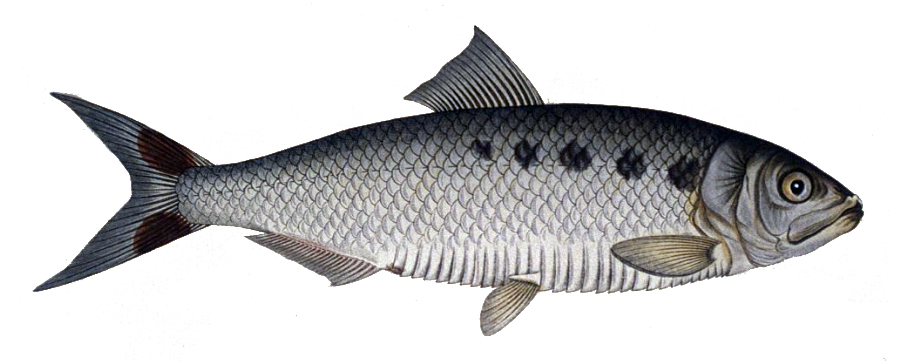
Allis Shad
Alosa alosa
Photo: Photo: Wikimedia Commons, CC BY-SA
Overview
The Allis Shad (Alosa alosa) is a large anadromous fish in the herring family, historically among the most important migratory fish of Western European rivers. Adults are silvery with a deeply forked tail, a distinctive dark shoulder spot behind the gill cover, and can reach up to 70 centimetres in length. This species spends most of its adult life in the Atlantic Ocean and coastal waters, returning to freshwater rivers to spawn in gravel-bottomed stretches with strong currents.
The Allis Shad is classified as Critically Endangered (CR) by the IUCN, with populations continuing to decline across its range, which once extended from Scandinavia and the British Isles south to Morocco and the Mediterranean coast of France. Dam construction and river channelization have blocked access to historic spawning grounds on rivers such as the Rhine, Gironde-Garonne, and Loire systems, drastically reducing available breeding habitat. Water pollution, sand and gravel extraction from riverbeds, and past overfishing during spawning migrations have compounded the species' decline, while climate-driven shifts in river temperature and flow further threaten remaining spawning success.
Some populations have already disappeared entirely from parts of northern Europe. On a more encouraging note, targeted conservation efforts are underway in France, where fish passes have been installed on several rivers and spawning habitat restoration projects are being trialled to reconnect the species with upstream breeding grounds, offering a measured basis for cautious optimism. Continued monitoring and habitat connectivity work remain essential if the species' historic range is to be recovered.
The Allis Shad faces severe population declines primarily due to river damming and weir construction that blocks access to spawning grounds in freshwater rivers. Overfishing in both marine and estuarine environments has further reduced breeding populations, while water pollution and habitat degradation in river systems have compromised spawning success and juvenile survival rates.
Habitat
Allis Shad are anadromous fish that spend most of their adult lives in marine coastal waters and estuaries, migrating into freshwater rivers to spawn. They require clean, fast-flowing river systems with gravel beds for successful reproduction and juvenile development.
Conservation measures underway
Other threatened species in CLUPEIDAE


Threatened in Belgium

Frequently asked questions
Why is Allis Shad classified as Critically Endangered?
Where does Allis Shad live?
What are the main threats to Allis Shad?
Get weekly conservation intelligence
One short digest a week of the most striking species and country data we ship, plus breaking conservation news paired with our database where it matters.
Free, no spam. One-click unsubscribe in every email.