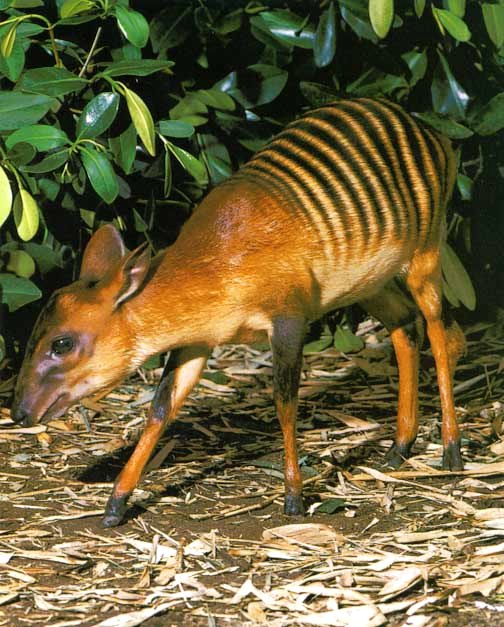
Cephalophus adersi
VUVulnerable

Cephalophus adersi

**Aders' Duiker (Cephalophus adersi)** Aders' duiker is a small antelope endemic to coastal East Africa, distinguished by its reddish-brown coat with distinctive white patches on the legs and rump. Standing approximately 30cm at the shoulder and weighing 7-12kg, it represents one of Africa's smallest duiker species.

Decreasing

Population trend

3

Countries

Photo: Wikimedia Commons (CC) via https://en.wikipedia.org/wiki/Aders's_duiker

01Classification

Taxonomy & Classification

Kingdom

ANIMALIA

Phylum

CHORDATA

Class

MAMMALIA

Order

ARTIODACTYLA

Family

BOVIDAE

Genus

Cephalophus

Cephalophus adersi belongs to the family BOVIDAE, order ARTIODACTYLA, within the MAMMALIA class.

02Description

Species Profile

**Aders' Duiker (Cephalophus adersi)** Aders' duiker is a small antelope endemic to coastal East Africa, distinguished by its reddish-brown coat with distinctive white patches on the legs and rump. Standing approximately 30cm at the shoulder and weighing 7-12kg, it represents one of Africa's smallest duiker species. These solitary, primarily nocturnal animals feed on fallen fruits, leaves, and shoots, playing a crucial role as seed dispersers in their forest ecosystems. The species has an extremely restricted range, occurring only in Kenya's Arabuko-Sokoke Forest and small forest fragments in the Dodori area, plus Zanzibar's Jozani-Chwaka Bay National Park in Tanzania. They inhabit dense coastal forests and thickets, requiring continuous canopy cover for protection and foraging. Aders' duiker faces severe threats from habitat fragmentation and loss due to agricultural expansion, logging, and human settlement. In Kenya, the Arabuko-Sokoke Forest experiences pressure from surrounding communities for farmland and fuelwood collection. On Zanzibar, tourism development and expanding agriculture continue to reduce available habitat. Hunting for bushmeat poses an additional threat, though its extent varies by location. Conservation efforts include habitat protection through national park designation in Zanzibar and forest reserve status in Kenya. Community-based conservation programs work with local populations to reduce human-wildlife conflict and provide alternative livelihoods. Research initiatives monitor population dynamics and habitat requirements. The species' outlook remains precarious due to its tiny, fragmented range and ongoing habitat pressures. Without sustained conservation intervention and effective habitat protection, Aders' duiker faces continued decline toward potential extinction.

Based on the provided threat data, the specific threats facing Aders' duiker have not been formally assessed or documented. Without a proper threat assessment, it's impossible to identify what dangers this species faces or understand the severity of different pressures on its survival. The status of whether threats are increasing, stable, or decreasing cannot be determined without this essential threat information.

Key Facts

IUCN StatusVulnerable (VU)
TrendDecreasing
GroupMammals
03Habitat

Habitat & Distribution

ForestMajorMarine coastal/supratidalMajorShrublandMajor
04Threats

Threats

Annual & perennial non-timber crops

Ongoing

Hunting & trapping terrestrial animals

Ongoing

Livestock farming & ranching

Ongoing

Logging & wood harvesting

Ongoing
05Conservation

Conservation Actions

Site/area protection
Ex-situ conservation
06Range

Found in 3 Countries

Community

Community Sightings

Report a sighting

No community sightings yet. Be the first to report!

07Sources

Sources & Attribution

How to Cite

IUCN: IUCN (2025). The IUCN Red List of Threatened Species. Version 2025-1. Available at: https://www.iucnredlist.org. doi:10.2305/IUCN.UK.2025-1.RLTS

GBIF: GBIF.org (2025). GBIF Home Page. Available at: https://www.gbif.org

This page: SpeciesRadar (2026). Cephalophus adersi (Cephalophus adersi). SpeciesRadar: Intelligence for Earth's Biodiversity. Available at: https://speciesradar.org/species/aders-duiker

Full citation guide & data usage terms