Gharials: Fort Worth Zoo's Record Hatch
A Record Clutch Offers Hope for a Vanishing Crocodilian
Eight gharial crocodiles have hatched at the Fort Worth Zoo this summer, the institution's largest clutch yet and its fourth consecutive year of successful breeding for the critically endangered species. The achievement, first reported by the Fort Worth Report, cements the Texas zoo's standing as the only institution in North America to repeatedly breed gharials, a long-snouted river crocodilian that has become one of the rarest large reptiles on Earth.
Gharials (Gavialis gangeticus) are instantly recognizable by their narrow, elongated jaws lined with interlocking teeth built for snatching fish, and in mature males, a bulbous growth at the snout tip called a "ghara." Once found throughout the river systems of the Indian subcontinent, the species has collapsed to a fraction of its former range, surviving today mainly in fragmented, fast-flowing stretches of rivers in India and Nepal. Fewer than a few hundred breeding adults are believed to remain in the wild, a decline driven by dam construction, sand mining, fishing net entanglement, and the loss of undisturbed riverbank nesting sites.
Zoo officials described the hatching as the product of years of patient trial and error in replicating the species' specific nesting and incubation needs — conditions that have proven difficult to reproduce even in zoos with decades of crocodilian experience. The achievement places Fort Worth Zoo in rare company among global breeding centers, most of which are concentrated in gharial range countries rather than in North America.
What This Breeding Success Means
A single clutch of eight hatchlings will not reverse decades of habitat loss, but conservation biologists have long pointed to captive breeding as an essential insurance policy for species whose wild numbers have fallen into the low hundreds. Repeated breeding success, rather than a one-off event, is what actually matters for long-term population security — it signals that an institution has solved the husbandry puzzle reliably enough to contribute genetically diverse, healthy young animals that could eventually support reintroduction programs or bolster other zoo populations.
For a species as narrowly distributed and demographically fragile as the gharial, every surviving clutch counts disproportionately. Crocodilian nests are vulnerable to flooding, predation, and human disturbance in the wild, and hatchling survival rates in natural rivers are notoriously low. A controlled, predator-free hatching environment can produce in a single season what might take a wild population several years to achieve naturally.
Lessons From a Close Relative
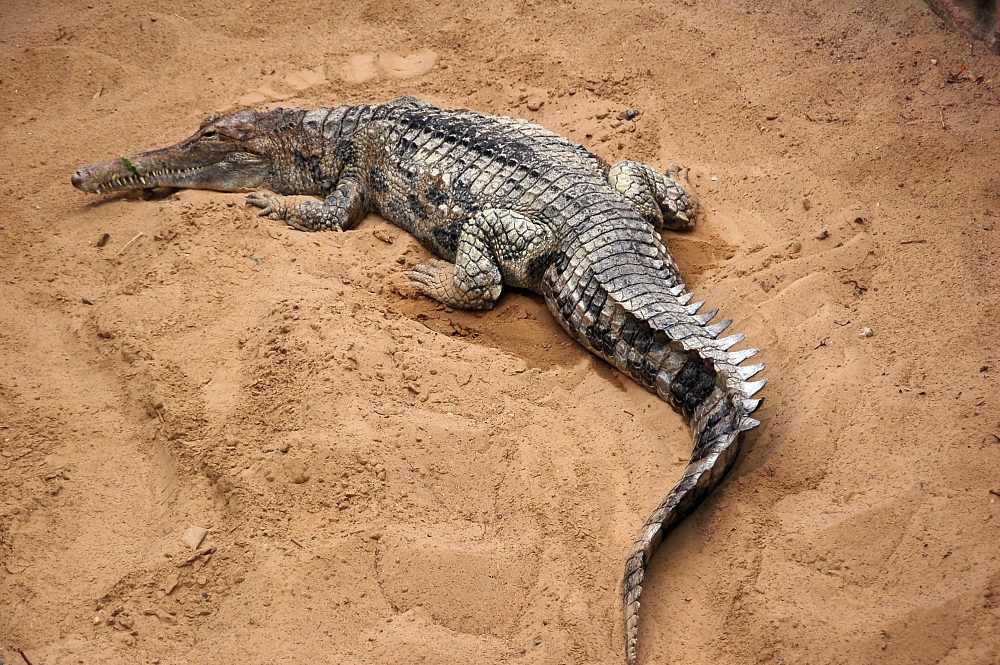
The true gharial's story has an instructive parallel in the False Gharial, Tomistoma schlegelii, a separate but similarly long-snouted crocodilian native to the swamps and blackwater rivers of Borneo, Sumatra, and the Malay Peninsula. Despite the similar name and appearance, the False Gharial is only distantly related to the true gharial, but both species share a reliance on quiet, undisturbed freshwater habitat and both have suffered from wetland drainage and riverside development.
The False Gharial is currently listed as Endangered on the IUCN Red List, one category less severe than the true gharial's Critically Endangered status, though its population trend raises similar concerns among specialists who track the species' profile. Unlike the gharial, which nests on open sandbanks, the False Gharial builds mound nests in swamp forest, making it especially sensitive to the peatland clearing and conversion to agriculture that has swept through Southeast Asia in recent decades. Its story underscores a pattern seen across long-snouted, fish-eating crocodilians worldwide: specialized anatomy that makes a species an efficient hunter can also make it exceptionally vulnerable once its narrow habitat niche disappears.
The Bigger Picture for River Crocodilians
Conservationists tracking both species point to a shared set of pressures that have pushed long-snouted crocodilians toward the brink:
- Dam and barrage construction that fragments river habitat and alters water flow needed for nesting
- Sand mining and bank erosion that destroys the sandbars and mounds crocodilians depend on for egg-laying
- Entanglement in fishing nets, which kills adults and juveniles indiscriminately
- Conversion of swamp forest and floodplain to agriculture, eliminating nesting and foraging grounds
- Illegal poaching for skins and eggs in some parts of their range
Zoos participating in cooperative breeding programs, including Fort Worth's gharial effort, are increasingly viewed as a critical backstop while habitat protections and river restoration work proceed more slowly in range countries. Successful, repeatable hatchings allow institutions to refine incubation temperature and humidity protocols, share expertise with partner zoos, and build toward the genetic diversity needed for any future reintroduction effort.
Outlook
The eight new hatchlings will be raised at the Fort Worth Zoo before decisions are made about their long-term placement, following protocols used in previous breeding seasons. Conservationists say the consistency of the zoo's results over four years, rather than the record clutch size alone, is the most encouraging signal for the species' future in professional care. Whether similar institutional successes can be achieved for the False Gharial remains an open question, but the parallel challenges facing both species suggest that lessons learned from one may eventually inform conservation strategy for the other.
Frequently Asked Questions
Is the False Gharial the same species as the true gharial?
No. They are only distantly related crocodilians that share a similar long, narrow snout shape adapted for catching fish, but they belong to different lineages and have different native ranges.
What is the IUCN status of the False Gharial?
The False Gharial, Tomistoma schlegelii, is listed as Endangered on the IUCN Red List. You can read more on its species profile.
Why is captive breeding important for species like these?
With wild populations reduced to small, fragmented groups, captive breeding programs provide a genetic safety net and can supply healthy young animals for future reintroduction or population support efforts.
Where did this record hatching take place?
The eight gharial hatchlings emerged at the Fort Worth Zoo in Texas, as reported by the Fort Worth Report.
Get weekly conservation intelligence
One short digest a week of the most striking species and country data we ship, plus breaking conservation news paired with our database where it matters.
Free, no spam. One-click unsubscribe in every email.