Casey's Larkspur: A Flower on the Edge
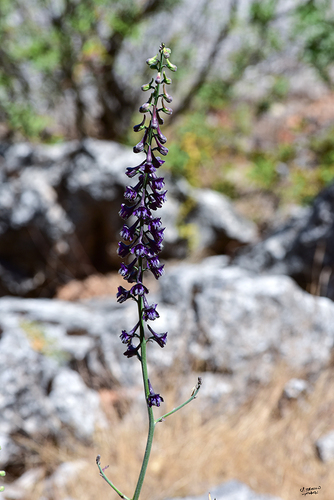
A Wildflower Most People Will Never See
Somewhere on a sun-baked hillside in coastal California, a tall spike of deep blue-purple flowers pushes up through grassland before the summer drought arrives. It blooms, it sets seed, and then it vanishes back into the soil for another year. Most people will never know it exists. Casey's Larkspur (Delphinium caseyi), a member of the buttercup family Ranunculaceae, is listed as Critically Endangered on the IUCN Red List — and remarkably, no one currently knows how many individuals remain.
| Attribute | Data |
|---|---|
| Common name | Casey's Larkspur |
| Scientific name | Delphinium caseyi |
| IUCN Red List status | Critically Endangered (CR) |
| Known population | Unknown |
| Population trend | Unknown |
| Range | Coastal California, USA |
| Habitat | Grasslands, oak woodlands, chaparral margins |
| Primary threats | Habitat destruction, invasive species, climate change |
Key Finding: Casey's Larkspur is formally classified as Critically Endangered — the second-highest extinction risk category before "Extinct in the Wild" — yet no population count or trend estimate currently exists, leaving conservationists to manage a species whose true survival odds remain a mystery.
That gap between "Critically Endangered" and "unknown population" is not a bureaucratic footnote. It is a warning sign. A species can only earn the CR designation when experts find compelling evidence of extreme range restriction, habitat loss, or population decline — even without a hard number attached. For Casey's Larkspur, the absence of a census is itself part of the story: a narrow-range endemic plant that has slipped through the cracks of botanical monitoring even as the ground beneath it is bulldozed, paved, and grazed.

Why This Plant Lives Nowhere Else
Casey's Larkspur is a California specialist in the truest sense. It grows only in grasslands, oak woodlands, and chaparral margins along the coast, favoring well-drained soils on slopes and hillsides shaped by a Mediterranean climate — cool, wet winters followed by long, dry summers. This is the same climate rhythm that governs much of coastal California's native flora, and it means the plant's entire life cycle is timed to a narrow window of soil moisture.
A Perennial Herb Built for a Vanishing Rhythm
As a moisture-dependent perennial herb, Casey's Larkspur depends on predictable winter rains to trigger germination and spring growth. Disrupt that rhythm — through drought, erratic rainfall, or soil degradation — and the plant's reproductive window can close before seeds mature. Unlike widespread, generalist plants that can tolerate a range of conditions, this larkspur has no backup habitat to retreat to. Its entire genetic future is tied to a handful of hillside populations in a single coastal region.
The Squeeze of Urban California
California's coastal zones are among the most desirable — and most developed — landscapes in North America. That popularity is precisely the problem:
- Urban development is converting grassland and woodland habitat into housing, roads, and commercial land at a pace that leaves little room for narrow-range endemics
- Agricultural expansion further fragments the remaining hillside and chaparral margins the species depends on
- Invasive plant species outcompete Casey's Larkspur for light, water, and nutrients, while also altering the chemistry of the soils it needs to germinate and grow
- Climate change is shifting precipitation patterns and increasing drought frequency, directly threatening a plant whose survival hinges on reliable seasonal moisture

When "Unknown" Becomes the Most Dangerous Word in Conservation
For many Critically Endangered animals, we at least have a number — a stark count of individuals left in the wild, like the dwindling populations tracked for species such as the Bengal Florican or other grassland specialists facing collapse. Plants like Casey's Larkspur rarely get that same scrutiny. Botanical surveys are chronically underfunded compared to charismatic vertebrate research, and narrow-range herbs blooming briefly on private or undeveloped hillsides are easy to overlook entirely.
A species can be erased from a landscape before anyone finishes counting it.
This is why the "unknown" population trend listed for Casey's Larkspur matters so much. It does not mean the species is safe by default — IUCN assessors reached the Critically Endangered conclusion based on the severity and immediacy of habitat threats, even without a precise headcount. It means the clock may already be running out faster than the data can keep up.
What Protecting a Plant Like This Actually Requires
Safeguarding Casey's Larkspur is not a single fix — it demands coordinated action across land management, research, and policy:
- Systematic population surveys to finally establish a baseline count and trend
- Protection of remaining grassland, oak woodland, and chaparral habitat from further subdivision and development
- Active control of invasive plant species in and around known populations
- Seed banking and ex-situ cultivation as insurance against localized extinction
- Monitoring of soil moisture and precipitation patterns to anticipate climate-driven stress
Related on SpeciesRadar: Helena's Marsupial Frog (EN), Striped Smoothhound (CR).
Frequently Asked Questions
What does Critically Endangered mean for a plant like Casey's Larkspur?
It means the species faces an extremely high risk of extinction in the wild, based on criteria such as restricted range, habitat decline, or population threats — even when, as with this species, exact population numbers are not yet known.
Where is Casey's Larkspur found?
It is native to coastal California, growing in grasslands, oak woodlands, and chaparral margins on well-drained hillside soils within a Mediterranean climate zone.
Why don't we know how many Casey's Larkspur plants are left?
Narrow-range endemic plants often receive far less survey effort than high-profile animals, and this species' localized, seasonal blooming pattern makes it easy to miss during casual botanical surveys.
Can invasive species really threaten a native wildflower this badly?
Yes — invasive plants can out-compete native species for water and light while also changing soil chemistry, making conditions unsuitable for sensitive natives like Delphinium caseyi to germinate and establish.
What can be done to help species like this?
Protecting remaining habitat, funding targeted population surveys, controlling invasive species, and supporting seed banking programs are all concrete steps that can improve the species' odds of recovery.
Methodology: Data sourced from SpeciesRadar (speciesradar.org), drawing on IUCN Red List 2025-2, GBIF, and national red list assessments from multiple countries.
A Future That Still Has Room for Recovery
Casey's Larkspur has not vanished — and that distinction matters enormously. Critically Endangered is a warning, not a death sentence. Species once thought nearly lost, from California's own coastal flora to larger conservation icons protected under frameworks tracked across our country pages, have rebounded when habitat was secured and populations actively managed. With focused surveys to finally quantify its numbers, stronger protection of its remaining grassland and woodland habitat, and sustained control of invasive competitors, this quietly spectacular wildflower can still have a future on the California hillsides it calls home. You can explore its full record, alongside other Critically Endangered species like the Bengal Florican, on its SpeciesRadar species profile, and see how it compares to thousands of other imperiled species through our species explorer. Read the full threatened species pillar on SpeciesRadar to understand how plants like Casey's Larkspur fit into the broader global extinction crisis — and what it will take to turn the tide.
Get weekly conservation intelligence
One short digest a week of the most striking species and country data we ship, plus breaking conservation news paired with our database where it matters.
Free, no spam. One-click unsubscribe in every email.