Atewa Slippery Frog: First Captive Breeding
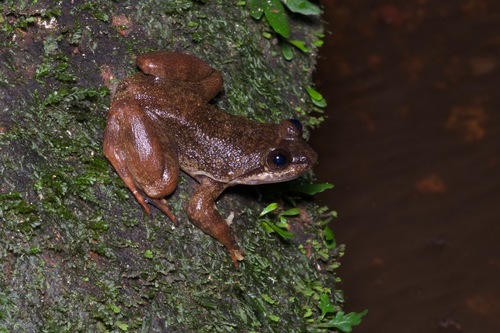
A Rare Amphibian Milestone at London Zoo
For a species with a foothold as precarious as its name suggests, the news out of London Zoo this month counts as a genuine breakthrough. Conservationists there have announced the first successful captive breeding of the Atewa slippery frog (Conraua sagyimase), a species classified as Critically Endangered on the IUCN Red List and found nowhere on Earth outside a single forest reserve in eastern Ghana.
The frogs bred at the zoo descend from a rescue mission mounted in the Atewa Forest Reserve, a biodiversity stronghold increasingly hemmed in by bauxite mining operations. According to The English Chronicle, the rescue was launched precisely because that mining pressure threatens to strip away the cool, fast-flowing streams the frogs depend on for survival. Breeding the species successfully in a controlled environment gives conservationists something they have never had before: a safety-net population insulated from what is happening on the ground in Ghana.
Why This Species Was So Hard to Breed
Amphibians as a group are notoriously difficult to breed in zoos, and stream-dwelling frogs like Conraua sagyimase are considered especially demanding. They require precise water chemistry, oxygen levels, temperature gradients, and current flow that mimic the headwater streams of the Atewa Range — conditions that are far easier to describe than to replicate inside an aquarium system. Keepers had to essentially reconstruct a slice of Ghanaian upland forest hydrology indoors before the frogs would show any interest in breeding at all.
That the attempt worked at all is a signal that the species' basic biology is now understood well enough to replicate reliably — a foundation that could eventually support reintroduction efforts if wild habitat can be secured. You can view the species' full profile, including its threat classification and background, on the Atewa slippery frog species page.
What This Means for a Single-Site Species
The significance of a captive breeding success is amplified enormously when a species' entire wild population is confined to one location. The Atewa slippery frog is endemic to the Atewa Range Forest Reserve, a small upland block of moist forest that also happens to sit atop one of Ghana's most valuable bauxite deposits. Mining exploration and clearance in and around the reserve have already fragmented habitat and altered water quality in the streams the frogs need to breed and forage.
Because there is no second wild population to fall back on, any localized disturbance — a new mining concession, a road cut through the watershed, sedimentation of a breeding stream — carries outsized risk for the species as a whole. A captive assurance colony changes that calculus. It does not remove the threat from the ground, but it removes the possibility that a single bad season in Ghana could translate into the frog's total disappearance.
- The species is restricted to the Atewa Range Forest Reserve in eastern Ghana, giving it one of the smallest known ranges of any amphibian in West Africa.
- Bauxite mining exploration inside and near the reserve threatens the clean, fast-flowing streams the frog needs for breeding.
- London Zoo's success marks the first known instance of the species reproducing in a managed care setting.
- The captive population now serves as an insurance policy against further habitat loss in Ghana.
The Wider Conservation Picture
Amphibians as a class are in deep trouble globally, and West African stream frogs sit near the sharp end of that crisis. Habitat loss from logging, agriculture, and — increasingly — mineral extraction has squeezed species like the Atewa slippery frog into ever-smaller refuges. Conservation groups working in Ghana have for years pushed for the Atewa Range to be upgraded to a national park, a designation that would offer far stronger legal protection than its current forest reserve status, which has not stopped exploratory mining activity.
London Zoo's parent conservation organisation has framed the breeding success as part of a broader strategy: buy time for species whose habitats are under active threat by establishing living populations outside the danger zone, while advocacy and fieldwork continue to push for stronger protections on the ground. It's a model that has worked, with mixed but real success, for other extremely range-restricted amphibians elsewhere in the world, where zoo-based breeding programmes have kept species alive through habitat crises that would otherwise have proven terminal.
What Happens Next
Zoo teams are expected to monitor the young frogs closely through their early development stages, since juvenile survival is often the most fragile phase for stream-breeding amphibians reared away from natural conditions. Longer term, conservationists will be watching whether Ghana's government moves to formalize stronger protections for the Atewa Range, and whether the mining pressure on the reserve eases or intensifies. A self-sustaining captive population, paired with genuine habitat security in Ghana, would represent the clearest possible path away from extinction for this frog.
Frequently Asked Questions
What is the Atewa slippery frog's conservation status?
It is classified as Critically Endangered on the IUCN Red List, reflecting its extremely restricted range and the ongoing threats to its only known habitat in Ghana's Atewa Forest Reserve.
Why is this breeding success significant?
It is the first recorded instance of the species reproducing in captivity, giving conservationists an insurance population that is protected from habitat destruction happening in the wild.
What is the main threat to the species?
Bauxite mining exploration and associated habitat disturbance in and around the Atewa Range threaten the clean, fast-flowing streams the frogs need to survive and breed.
Could captive-bred frogs eventually be released into the wild?
That would depend on securing adequate protection and habitat quality in the Atewa Forest Reserve first; for now, the captive population primarily functions as a safeguard against total loss of the species.
Get weekly conservation intelligence
One short digest a week of the most striking species and country data we ship, plus breaking conservation news paired with our database where it matters.
Free, no spam. One-click unsubscribe in every email.